
Key takeaways:
- AI cost governance is now a signal collection and attribution problem across cloud, hosted LLMs, data platforms, on-prem environments, GPUs, agents, developer tools, and SaaS.
- Department-level attribution helps assign ownership. FinOps and CloudOps teams also need workflow, model, agent, customer, developer user, session, and usage-pattern attribution to explain cost behavior.
- Public cloud appears in AI cost reporting at 68%. Agentic workflows and GPU infrastructure appear at 36%, even though both are among the hardest cost surfaces to govern.
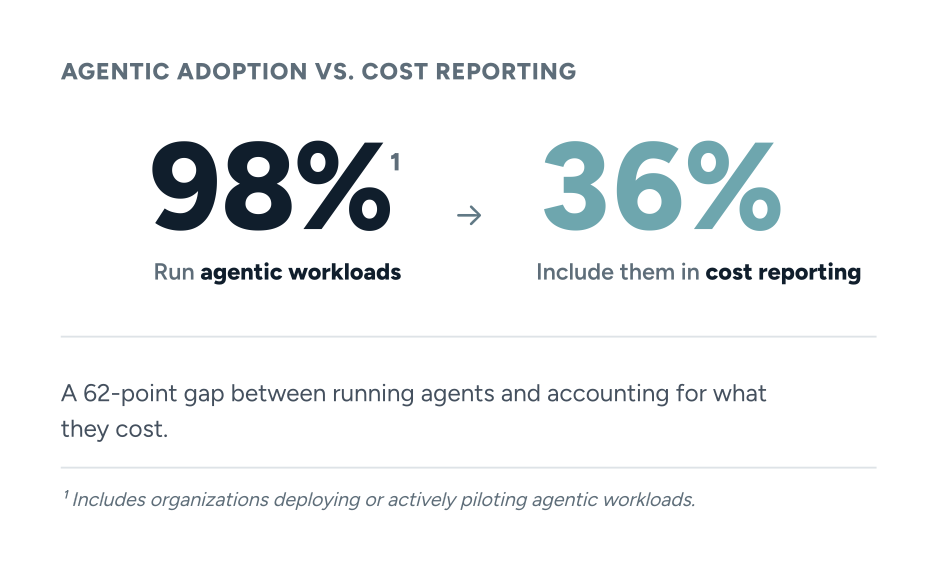
- 98% of organizations run agentic workloads, but only 36% include them in cost reporting. 15% cannot attribute agentic costs at any level.
- Detection lag now belongs on the FinOps scorecard. 46% of organizations have no real-time alert mechanism for AI cost overruns, 63% rely on manual review, and 35% discover overruns after the invoice arrives.
Who this is for: FinOps leaders, CloudOps leaders, FinOps practitioners, platform operations leaders, infrastructure finance partners, and teams responsible for AI cost reporting across cloud and hybrid environments.
AI cost attribution now runs past the cloud bill
The 2026 State of AI Cost Governance Report shows a familiar FinOps pattern reaching a new perimeter. AI spend can be tracked to a department or product, while the cost drivers sit deeper in the runtime path: workflows, agents, models, data queries, GPU jobs, developer tool sessions, and customer interactions.
That creates a different operating requirement for FinOps and CloudOps leaders.
Mavvrik’s full-stack AI cost governance model covers that broader shift in detail; this piece focuses on the two gaps inside it that hit FinOps hardest: agentic reporting and detection lag.
The work has expanded from allocation into signal collection, telemetry, and attribution. FinOps and CloudOps teams need to connect spend to the signals that explain cost behavior, then attribute those costs at the level where a team can act.
Attribution has to match the decision
Team and department attribution leads at 54%. Product and feature attribution ranks second at 53%. Those views are useful for showback, chargeback, budget ownership, and finance review.
| Attribution Method | 2026 Reporting Rate | What It Helps Answer |
|---|---|---|
| Team or department | 54% | Which group owns the budget? |
| Product or feature | 53% | Which product area created the cost? |
| Agent or workflow | 46% | Which process drove runtime behavior? |
| Model or provider | 43% | Which model choice changed unit cost? |
| Customer | 40% | Which customer or segment changed cost-to-serve? |
| Developer tool user | 29% | Which user or workflow created tool spend? |
The next layer explains why the cost moved. For FinOps, the operating rule is simple: align allocation to ownership, and align optimization to the runtime signal. Optimization needs agent, workflow, model, provider, customer, developer user, session, and usage pattern. For how that ownership layer turns into showback and chargeback in practice, see the full comparison.
Optimization needs agent, workflow, model, provider, customer, developer user, session, and usage pattern.
The reporting perimeter has moved past cloud
Cloud billing APIs are still the spine of cost management. They are no longer the edge of the map. The report shows where coverage starts to drop.
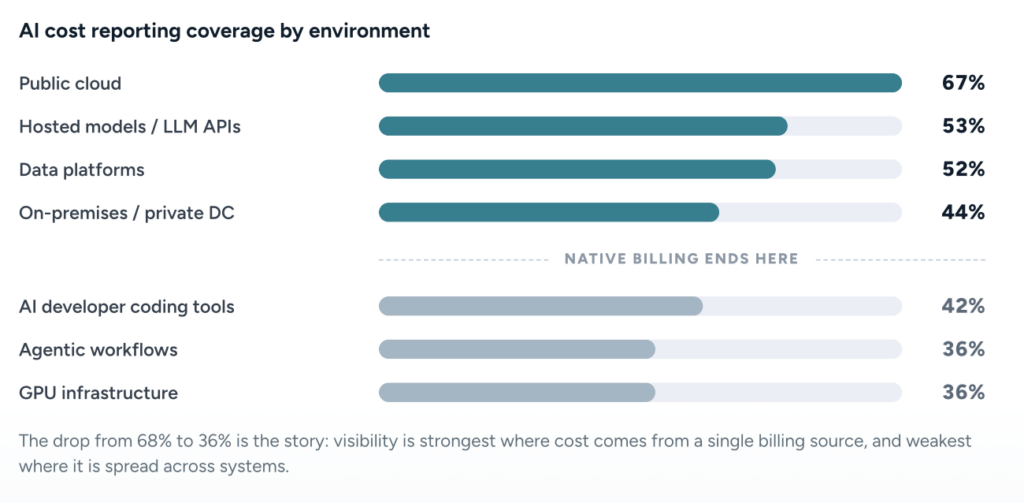
The order isn’t random. It tracks how far each environment sits from a native billing API. Public cloud and hosted models have one, so reporting there is largely an integration problem. Data platforms meter usage but rarely tag it to a workflow. On-prem has no billing feed at all. Developer tools get budgeted as software licenses instead of consumption. And agentic workflows and GPU jobs are lowest of all because the cost object itself – a session, a job – doesn’t exist until someone instruments it into being.
“If you just look at your model cost and you ignore your on-prem costs — if that’s where the workloads are running — you’re only getting part of the picture… there isn’t tagging, there isn’t a billing API.” — Sundeep Goel, Mavvrik
For a deeper look at why each environment’s billing gap behaves differently, see why AI infrastructure costs are hard to measure.
AI cost reporting needs billing data where it exists, telemetry where it does not, and metadata standards across both.
The practical implication is uncomfortable in an informative way. The FinOps perimeter now includes every surface creating AI cost, including surfaces without native billing APIs.
Agentic AI breaks retrospective cost reporting
Agentic costs are runtime costs. A single agent run may call a hosted model, retrieve data, query a warehouse, invoke an API, hit an error, retry, use a fallback model, run a tool action, and route to a human. Each step can create cost. Some failed steps still charge
“If you don’t understand what the cost of your agent workflow was before AI, you don’t understand how much it’s costing you now with AI.” — Larry Lubinsky, AlixPartners
The report found that 98% of organizations run agentic workloads, while only 36% include them in cost reporting. 15% cannot attribute agentic costs at any level, compared with 3% for general AI costs.
That is a different problem from standard cloud allocation. Retrospective reporting forces teams to work backward through logs, invoices, shared keys, traces, and partial metadata. Runtime instrumentation gives FinOps and CloudOps teams the cost trail before the workflow becomes too large to unwind.
Agentic cost reporting should capture:
- Session ID
- Agent ID
- Workflow or task type
- Model and provider
- Tool actions
- Retry count
- Token data
- Latency and error state
- Data query IDs
- GPU job metadata
- Environment and owner tags
This is where FinOps gets closer to engineering telemetry because the cost event lives inside the runtime path –- the same path Mavvrik already instruments for Claude Code cost allocation and GitHub Copilot cost attribution.
Detection Lag is now a FinOps metric
Detection lag is the time between cost behavior and cost awareness. For consumption-based AI, a 30-day detection lag gives an expensive pattern time to repeat across sessions, agents, customers, and workflows. By the time the invoice arrives, the system has already taught itself a costly habit.
The report found:
- 46% have no real-time alert mechanism for AI cost overruns.
- 63% rely on manual review during reporting cycles.
- 35% discover overruns only after the invoice arrives.
FinOps and CloudOps teams should track detection lag alongside forecast variance, allocation coverage, anomaly response time, and budget burn.
A useful AI cost alert should fire against the driver behind the cost. Examples include per-session spend, retry count, model routing, query volume, GPU job duration, idle GPU time, context size, retrieval volume, and developer tool usage.
Data platform overages deserve more attention than token dashboards
Token dashboards are essential, but the report points to a bigger source of surprise. 47% of organizations cite data platform usage overages as a top unexpected AI cost. LLM token costs follow at 43%. Agent retry and orchestration overhead appears at 29%.
For FinOps and CloudOps, this changes where investigation starts. AI cost reporting should extend into the data layer (see why AI workloads drive Databricks and Snowflake costs for the mechanics) because a support agent can look cheap at the model layer and expensive at the service layer. A support agent can look cheap at the model layer and expensive at the service layer because retrieval fans out across multiple tables, semantic search misses cache, or retry logic repeats data work.
Token totals catch part of the story. Data telemetry explains why the run got heavy.
A practical example: one agent, several cost signals
Picture an AI support agent tied to a customer-facing product.
A department-level report says Customer Support owns the budget. A product-level report says the support automation feature created the spend. Both views are useful.
Then one session gets expensive.
The agent classifies the case with a hosted LLM. It retrieves context from a vector database. It runs warehouse queries to pull customer history. It triggers a public cloud function to check billing status. It sends a high-complexity path to a GPU-hosted reranker. Two tool calls fail and retry. A developer later uses an AI coding tool to inspect the related service behavior.
A department report answers who owns the budget.
Session-level attribution explains why the run became expensive: premium customer tier, large retrieval context, repeated warehouse queries, fallback model use, GPU reranking, and retry overhead.
That changes the next action:
- Finance can allocate budget.
- FinOps can run showback by product, workflow, and customer.
- CloudOps can review caching, GPU queues, and query patterns.
- Engineering can tune prompts, retry limits, tool calls, and model routing.
- Product can use cost-to-serve data to price with fewer surprises.
What FinOps and CloudOps should do next
FinOps and CloudOps teams do not need to throw away the cloud cost operating model. They need to extend it.
Start with these moves:
- Extend reporting beyond cloud invoices. Public cloud stays in the model. Add hosted LLMs, data platforms, on-prem infrastructure, GPUs, agentic workflows, developer tools, and AI SaaS.
- Standardize metadata before usage scales. Require owner, product, feature, customer, environment, model, provider, workflow, agent, session, data source, GPU job, and developer user where those fields apply.
- Instrument agents at deployment. Capture model calls, tool actions, retries, orchestration steps, latency, errors, data queries, and session context before the cleanup project begins.
- Add data platform and GPU signals. Warehouse queries, vector database usage, data movement, GPU utilization, GPU idle time, and job metadata should sit next to token and cloud spend.
- Bring AI coding tools into reporting. Seat count is the starting point. Usage by developer user, team, session, model, operation, and workflow is where accountability improves.
- Define alert thresholds by runtime driver. AI alerts should track the behavior creating cost: per-session spend, query volume, retry rate, model routing, GPU queue time, GPU idle time, token burn rate, and developer tool usage spikes.
- Align showback and chargeback to the level where teams can act. Department-level chargeback may satisfy finance. Product, workflow, customer, agent, and session-level showback gives operators something to fix.
How Mavvrik approaches AI cost governance for FinOps and CloudOps
Mavvrik treats AI cost governance as an attribution and control problem across AI, cloud, GPUs, agents, data platforms, developer tools, SaaS, and hybrid infrastructure.
That means three practices for FinOps and CloudOps teams.
- Extend cost coverage beyond cloud billing. Mavvrik brings those cost surfaces into one governance model so FinOps and CloudOps teams can report on the full footprint, including environments where a native billing API does not exist.
- Attribute cost to the level where action happens. Spend needs to connect to team, product, feature, customer, model, provider, workflow, agent, session, developer user, environment, and usage pattern. Mavvrik uses that context to support allocation, showback, chargeback, cost-to-serve, forecasting, anomaly review, and optimization.
- Move detection closer to runtime. Real-time alerts, anomaly detection, budget thresholds, forecast variance tracking, and cost-to-serve reporting help FinOps teams act before spend becomes an invoice surprise.
Three ways to continue from here:
- Download the 2026 State of AI Cost Governance Report to benchmark AI cost visibility, forecasting, attribution, and reporting coverage.
- Watch the 2026 panel discussion: Mavvrik’s Sundeep Goel, Benchmarkit’s Ray Rike, ISG’s Kathy Rudy, and AlixPartners’ Larry Lubinsky unpack the attribution and visibility-cliff data live.
- Take the Product Tour to see how cost visibility, allocation, alerts, and governance work across cloud, GenAI, agents, GPU, on-prem, and SaaS.
FAQs
Why is AI cost attribution harder than cloud cost allocation?
Cloud cost allocation usually starts from structured billing data. AI attribution has to connect runtime behavior across models, agents, tools, data queries, GPU jobs, developer users, products, and customers.
What should FinOps track beyond token spend?
Track data platform usage, GPU utilization, model and provider choice, agent retries, orchestration steps, tool calls, developer user activity, and cost per workflow, session, customer, and feature.
When should AI cost alerts fire?
AI cost alerts should fire when runtime drivers move early in the cycle. Good triggers include unusual query volume, retry spikes, model routing changes, GPU idle time, GPU queue time, and per-session cost spikes.
Should AI coding tools be part of FinOps reporting?
Yes. AI coding tools create variable usage patterns across developer users, sessions, models, teams, and workflows. Seat-level reporting alone leaves FinOps without enough context for showback, chargeback, or tool consolidation decisions.
How should FinOps handle agentic cost attribution?
Start instrumentation before scale. Capture agent ID, workflow, session, model, provider, tool action, retry count, data query, GPU job, owner, and environment so cost can be traced to the run that created it.
Written by:

Lindsey Tishgart
VP of Marketing @ Mavvrik
Lindsey is VP of Marketing at Mavvrik, where she focuses on the growing cost of AI and how enterprises can scale it responsibly. She writes and thinks about AI economics: how unchecked spend creates financial and operational risk, how AI investment connects to margin and ROI, and how finance, engineering, and AI leaders can bring real governance to a problem most companies are still ignoring.