


Key takeaways:
- AI spend is now a margin input. 81% of organizations report moderate-to-high gross margin impact from AI costs, including 63% reporting a 6–15 percentage-point decrease and 18% reporting a decrease of more than 16 points.
- Forecasting is where finance loses control. 98% track AI infrastructure costs and 95% assign formal AI budgets, yet only 11% forecast AI spend within ±10% accuracy.
- Cost surprises are already changing business decisions. 62% say unexpected AI costs materially altered a business decision in the past year, including 49% that repriced AI-powered products and 40% that escalated the issue to executives or the board.
- COGS-based tracking is still missing from too many finance models. Only 30% measure AI costs as a percentage of COGS, while 70% have not required COGS-based AI cost tracking.
- The CFO control point is pre-deployment. Finance needs cost-to-serve, driver-based forecasting, attribution by product and workflow, and alert thresholds before AI features, agents, or developer tools scale.
Who this is for: CFOs | FP&A leaders | Finance operators | Executive teams responsible for margin protection, AI investment approval, pricing discipline, and financial controls across AI, cloud, and hybrid costs.
AI cost is now in the margin file
A CFO can approve the AI budget, see the monthly spend, and still miss the financial exposure.
That is the uncomfortable finding in the 2026 State of AI Cost Governance Report from Mavvrik and Benchmarkit. Across 396 organizations surveyed in April and May 2026, AI costs are already shaping budget reviews, pricing decisions, product investments, and board discussions. The issue for finance is precision: spend is being tracked, but the cost model is not complete enough to forecast, price, or defend the investment.
That makes AI cost governance a finance control issue. The CFO mandate is to move cost review earlier, require better attribution data, and make sure AI spend is measured against the financial outcomes it affects.
Tracking AI costs can still leave the forecast exposed
The forecast bands show that the problem is not whether finance has a budget. It is whether the budget can absorb the variability of consumption-based AI.
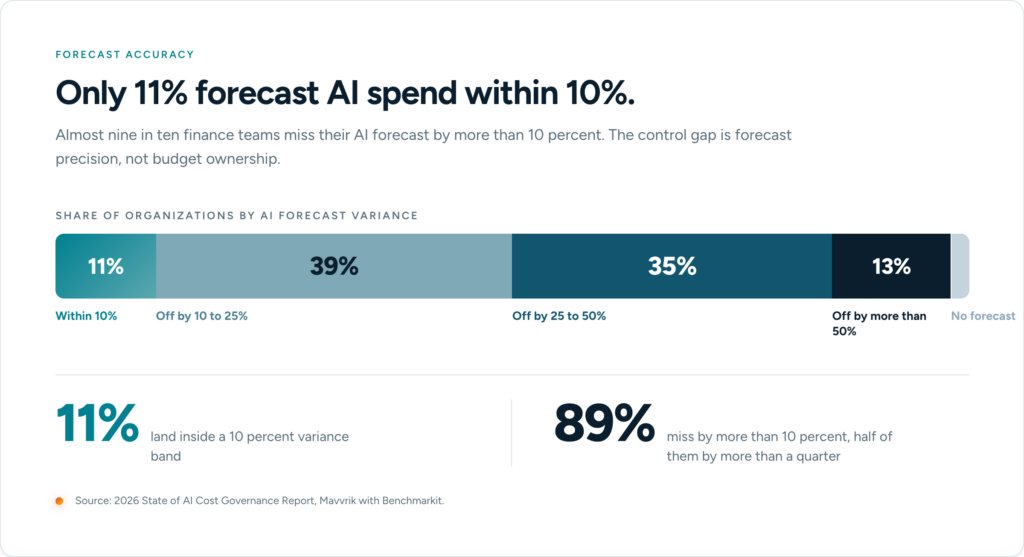
Source: 2026 State of AI Cost Governance Report; 396 organizations surveyed in April and May 2026.
For consumption-based AI, fixed-cost extrapolation is unlikely to be sufficient on its own. If the forecast cannot hold within a usable range, finance cannot price confidently, protect margin, or approve new AI investments with a complete cost picture.
A tracked cost can still be poorly governed. A budgeted cost can still be badly forecasted. A line item can still arrive too late to protect margin.
AI spend is driven by runtime behavior. A single budget line can be shaped by model choice, workflow design, retry behavior, data platform usage, GPU demand, and developer tool adoption. The report found that 60% of organizations rate consumption-based AI forecasting as a major or moderate challenge.
Classify AI spend as COGS or OPEX before it reaches the board
The report shows how uneven the finance model still is:
- 30% measure AI costs as a percentage of COGS. That is the metric tied most directly to gross profit.
- 56% measure AI costs against revenue. That helps benchmark spend against top-line growth, but it gives finance a weaker read on feature-level margin.
- 70% have not required COGS-based AI cost tracking. For customer-facing AI, that leaves finance approving product investments without the clearest view of unit economics.
The distinction gets expensive when AI is embedded in a product. Every customer session, output, and model call can become part of cost-to-serve. Product AI needs feature-level and customer-level attribution before pricing, packaging, or investment decisions are made.
Workflow AI belongs in a separate finance view. It flows through OPEX as employee usage, workflow volume, and operational activity. The cost may show up in department budgets instead of gross margin, but it can still distort productivity assumptions, headcount planning, and budget allocation.
Finance needs both categories separated before approval:
- Product AI: measure cost-to-serve, COGS impact, cost per inference, cost per customer, and feature-level margin.
- Workflow AI: measure agent cost, workflow cost, model usage, developer-user spend, and department-level budget impact.
Blending product AI and workflow AI into one number can reconcile cleanly and still weaken the decision. Mavvrik’s cost-to-serve approach connects infrastructure and AI consumption to products, features, customers, and teams so finance can evaluate the economics at the right level.
Cost surprises are reaching the board
- 49% repriced AI-powered products. That points to unit economics being reviewed after customers were already using the feature.
- 40% required executive or board-level escalation. A cost overrun became a leadership issue instead of staying inside the operating plan.
- 33% implemented emergency spending freezes. Spend controls were added after usage had already moved past the approved range.
- 31% reallocated budgets retroactively. Finance had to move dollars after the cost had already been created.
- 25% delayed or cancelled an AI initiative. The investment did not survive the cost review.
The timing data shows where control breaks down. 46% have no real-time alert mechanism for AI cost overruns, 63% rely on manual review during reporting cycles, and 35% discover overruns only after the invoice arrives.
Finance Implication: For consumption-based AI spend, invoice review is too late to protect the decision.
Forecast the full AI cost stack, not just token spend
Tokens are visible and easy to count, but they are only one part of the AI operating base. The report found that data platform overages were the most frequently cited source of unexpected AI cost, ahead of LLM token costs.
A finance-ready forecast therefore needs to include the full delivery stack: model and API consumption, retrieval and data platforms, networking, cloud and on-prem compute, GPU utilization, agent orchestration, and the engineering effort required to operate the system.
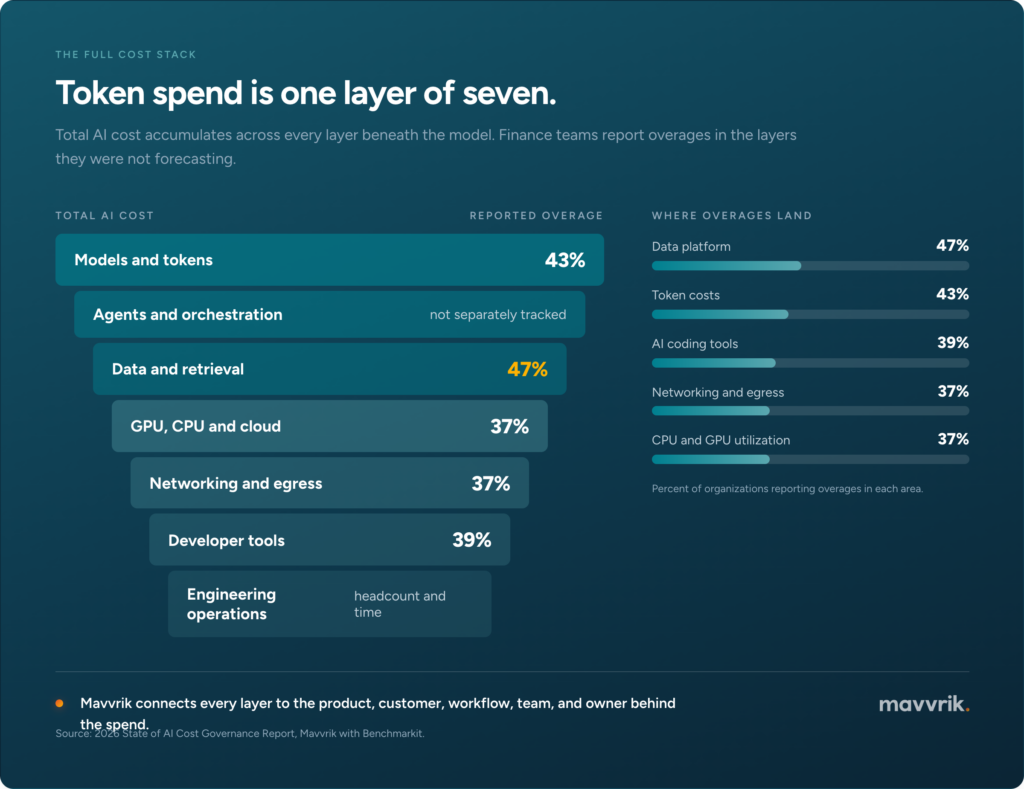
This is why full-stack AI cost governance matters to finance. Mavvrik brings AI, cloud, SaaS, GPU, data platform, and hybrid infrastructure costs into one financial view instead of treating provider invoices as the complete cost model.
Attribution must explain what created the cost
Department-level reporting gives finance an allocation view. It does not always provide the operating detail needed to forecast, price, or intervene.
The report found that team and department attribution leads at 54%, with product and feature attribution close behind at 53%. Those views answer who spent the money. The weaker layers are the ones finance needs for deeper cost control: agent or workflow at 46%, model or provider at 43%, customer at 40%, and developer tool user at 29%
Agentic AI raises the stakes. 98% run agentic workloads, but only 36% include them in cost reporting. Among organizations that can attribute agentic costs, only 37% attribute down to agent type and 37% to model or API call. Another 15% cannot attribute agentic costs at any level.
The practical test is simple: finance should be able to move from a variance to the product, customer, workflow, agent, model, or user that created it. Mavvrik supports that bridge by allocating shared AI and infrastructure costs across business dimensions that finance can use for forecasting, showback, chargeback, and margin analysis.
Developer AI tooling belongs in the AI budget
AI coding tools often enter the business through software licensing. Their cost behavior is closer to variable AI infrastructure.
The report found that 98% of organizations use AI coding tools, with an average of 2.4 tools per organization:
- Claude Code: 60%
- GitHub Copilot: 54%
- Amazon CodeWhisperer or Q Developer: 51%
- Codex: 47%
- Cursor: 22%
The finance view is still incomplete. Only 42% include AI developer tools in AI cost reporting, while 39% report costs exceeding expected license or usage levels.
Routing is part of the problem. These costs often move through software licensing, team allocations, or overhead, which keeps them outside the AI cost owner’s regular view. The spend may sit in a familiar budget category while behaving like part of the AI operating base.
Developer tooling also affects productivity assumptions. Speed, quality, and engineering capacity may justify the investment, but finance needs the combined tool footprint and the usage data behind it. Without that view, the investment case depends on partial cost and partial value.
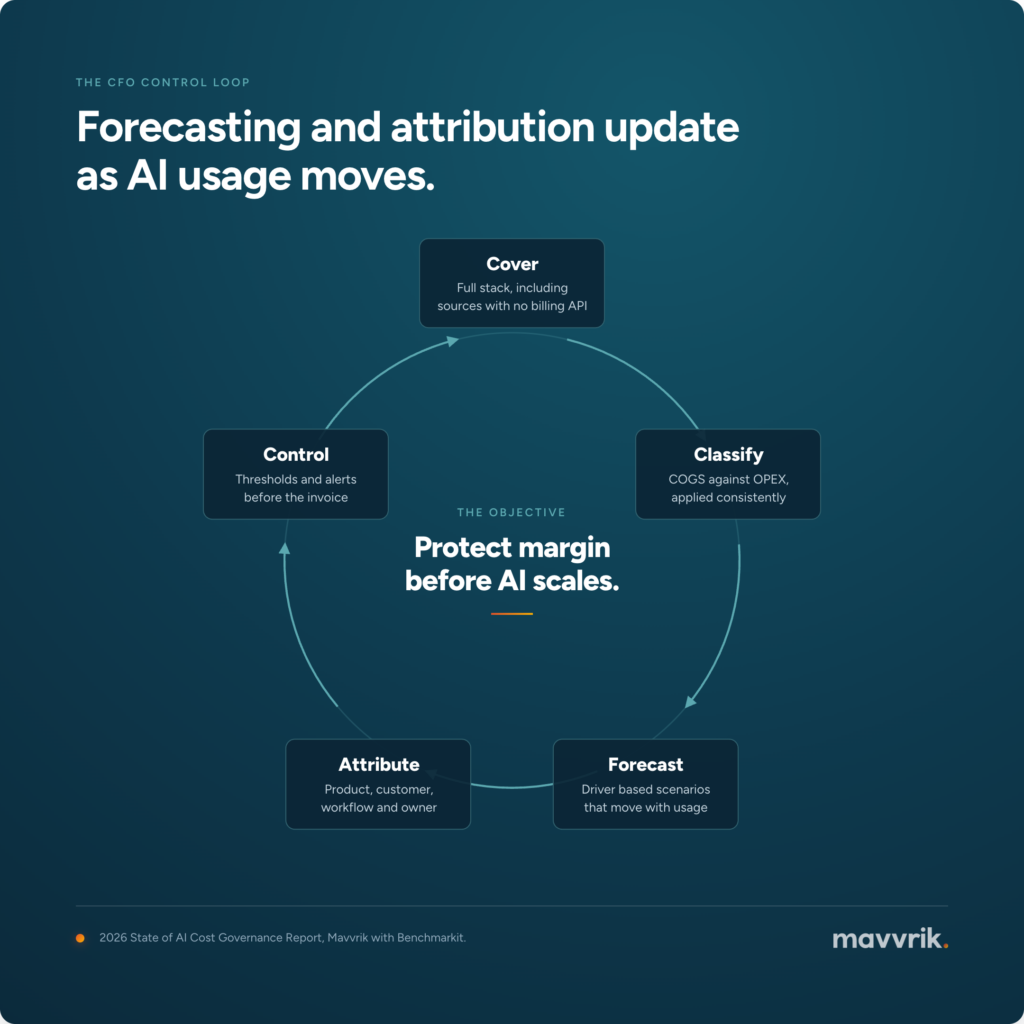
The CFO control model for AI spend
Finance does not need to own model configuration or agent design. It does need a control model that makes the economics visible before deployment and keeps them visible as usage changes.
| Control | What finance should require | Decision supported |
|---|---|---|
| Coverage | All AI, cloud, SaaS, GPU, data platform, developer tool, and hybrid costs | Is the cost base complete? |
| Classification | Product AI separated from workflow AI; COGS and OPEX treatment defined | Where will the spend affect the financial model? |
| Forecasting | Consumption drivers, volume assumptions, scenario ranges, and accountable owners | How much could cost change as usage scales? |
| Attribution | Product, feature, customer, workflow, agent, model, team, and user dimensions | What created the cost and who can act? |
| Guardrails | Pre-deployment approval, budget thresholds, real-time alerts, and variance review | Can finance intervene before the invoice? |
| Value | Cost-to-serve and cost-to-outcome measures tied to pricing, productivity, or revenue | Is the investment producing sufficient value? |
How Mavvrik approaches AI cost governance for finance
Mavvrik treats AI cost governance as a financial control model across AI, cloud, SaaS, and hybrid infrastructure.
For finance leaders, that comes down to three practices:
- Build coverage across the full stack. AI costs need to be collected from public cloud, hosted LLMs, data platforms, on-prem infrastructure, GPUs, agents, and developer tools, including environments where there is no native billing API.
- Allocate cost to the units finance can use. Product, feature, customer, workflow, agent, model, team, and developer-user attribution create the bridge between spend, margin, pricing, and accountability.
- Move controls before scale. Pre-deployment approval, real-time alerts, budget thresholds, and forecast variance tracking give finance a way to govern AI spend while the decision is still in front of the business.
Mavvrik helps finance teams connect AI, cloud, SaaS, and hybrid costs to the owners, products, workflows, and customers behind the spend, so usage can scale without spend outrunning value.
What are the next steps?
- Benchmark the exposure. Download the 2026 State of AI Cost Governance Report to compare your forecasting, attribution, and control gaps with 396 organizations.
- Map the full cost surface. Review how Mavvrik captures GenAI, agents, GPUs, data platforms, developer tools, cloud, and on-prem costs in one view. Take a tour of the platform →
- Build the finance control model. See how Mavvrik supports AI cost visibility, allocation, anomaly detection, forecasting, and budget guardrails. Learn more →
FAQs
Why should CFOs treat AI spend as a margin issue?
AI spend affects gross margin directly when it powers customer-facing products. In the report, 81% of organizations report moderate-to-high gross margin impact from AI costs, and 70% have not required COGS-based tracking.
Why can AI cost tracking fail to produce an accurate forecast?
Tracking can miss the fastest-moving cost drivers, including agents, GPUs, data platforms, on-prem environments, and developer tools. The report found that 98% track AI infrastructure costs, while only 11% forecast within ±10%.
What should finance require before approving a new AI product investment?
Finance should require cost-to-serve, COGS treatment, forecast drivers, attribution by feature and customer, alert thresholds, and a named accountable owner before deployment.
Should developer AI tools be included in AI cost governance?
Yes. In the report, 98% use AI coding tools, 39% report costs exceeding expectations, and only 42% include those tools in AI cost reporting. That is a finance visibility issue, even when the purchase routes through software licensing.
What is the difference between AI cost tracking and AI cost governance?
AI cost tracking shows what was spent. AI cost governance adds classification, attribution, forecasting, accountability, and controls so finance can act before spend affects margin or forces a business decision.
Written by:

Lindsey Tishgart
VP of Marketing @ Mavvrik
Lindsey is VP of Marketing at Mavvrik, where she focuses on the growing cost of AI and how enterprises can scale it responsibly. She writes and thinks about AI economics: how unchecked spend creates financial and operational risk, how AI investment connects to margin and ROI, and how finance, engineering, and AI leaders can bring real governance to a problem most companies are still ignoring.