
AI spending has moved from experimental to operational. It’s running in production. It’s embedded in products. It’s powering agents. And it’s generating costs across infrastructure that no single billing system was built to govern.
The result is what we keep hearing from teams: AI bill shock.
Costs show up as surprises on invoices instead of something finance and engineering can actually manage in real time.
Today, Mavvrik is introducing Full Stack AI Cost Governance. We are bringing together what customers already rely on for cloud, on-prem, GPU, SaaS, and LLM cost management, and adding agent-level cost tracking through a new SDK.
The result is unified visibility and control over AI spend and usage, across the entire stack.
The Gap Everyone Is Running Into
Most companies can tell you they’re investing in AI.
Very few can answer basic follow-ups:
- What did we spend on AI last month?
- Which teams drove that spend?
- What does it cost to support a specific feature, use case or customer?
Even when they can answer, it usually takes days of stitching together exports from different systems.
As our CEO, Sundeep Goel puts it: “Most companies can’t tell you what they’re spending on AI, let alone which teams drove it, which products it’s tied to, or how it’s affecting their margins. That gap used to be acceptable. It isn’t anymore.”
That gap is exactly what AI Cost Governance is meant to close.
Defining AI Cost Governance
AI Cost Governance is about bringing financial accountability to AI.
Not just tracking spend, but understanding it, attributing it, and taking action.
Traditional cloud cost tools weren’t built for this. They assume costs come from infrastructure and that tagging is enough to allocate spend, but AI breaks both of those assumptions.
Token-based pricing doesn’t map cleanly to teams or products, GPU workloads are shared and hard to attribute, and agentic workflows span multiple models, tools, and retries. So even when you have visibility, control is a different problem entirely.
Built on What Customers Already Use
AI cost governance extends the FinOps practice; it does not replace it.
Mavvrik already provides unified cost visibility and allocation across cloud, SaaS, on-prem, LLMs, and GPU infrastructure. Customers use our platform today to eliminate manual reporting, allocate costs across teams, and understand cost to serve.
Full Stack AI Cost Governance builds on that foundation.
We are adding:
- Agent-level cost tracking through an OpenTelemetry-based SDK
- Deeper attribution across AI workflows, not just infrastructure
- A unified model that connects AI usage to the rest of your cost data
So instead of stitching together new tools, customers extend what they already have and bring AI into the same financial system.
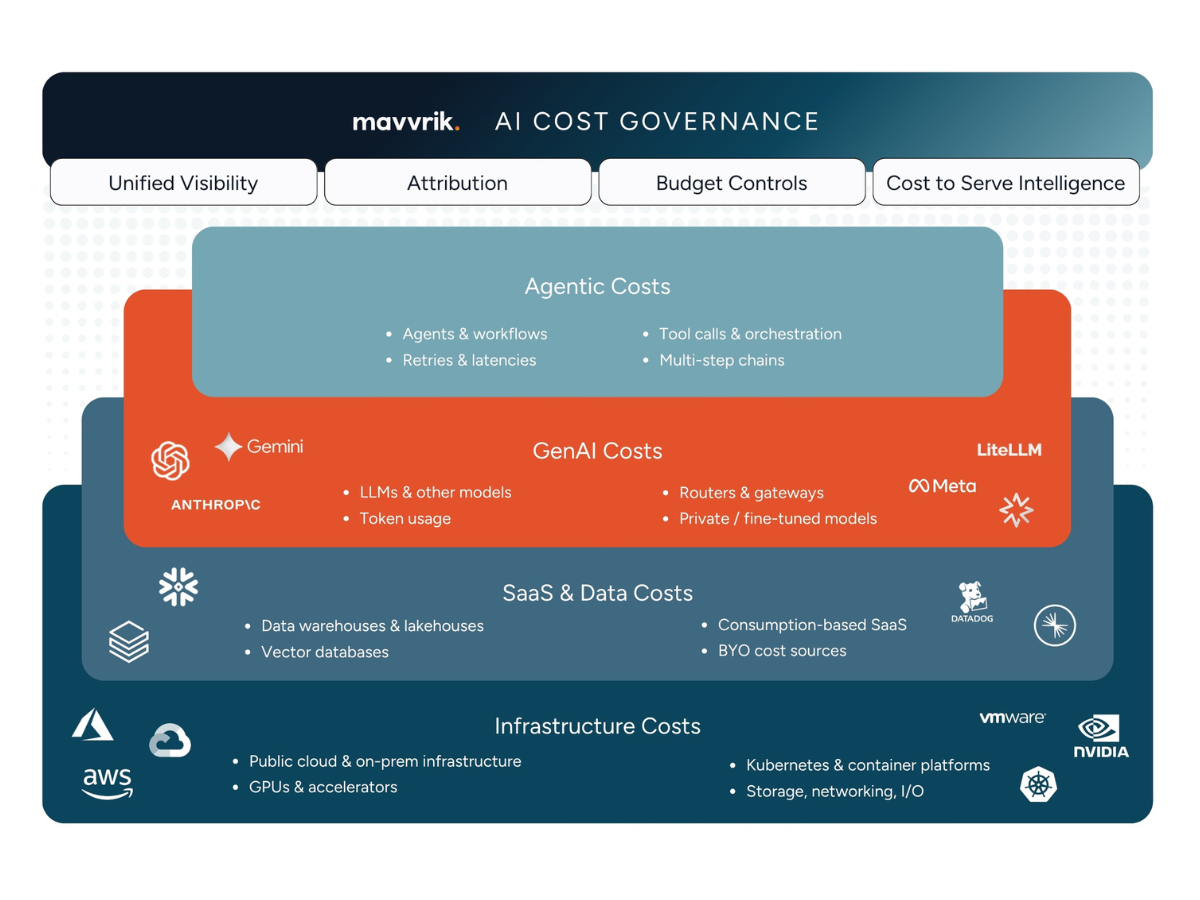
A Full-Stack View of AI Costs
The problem is not just cost. It is fragmentation.
AI spend is split across infrastructure, models, and tools with no shared system to tie it together.
Mavvrik connects those layers so you can understand what is happening.
- Infrastructure: Cloud, on-prem GPU clusters, Kubernetes, and accelerated compute
- SaaS and data platforms: The systems that feed and operationalize AI workloads
- GenAI services: Model usage across providers like OpenAI, Anthropic, and others
- Agentic workflows: Multi-step processes that combine models, tools, and orchestration
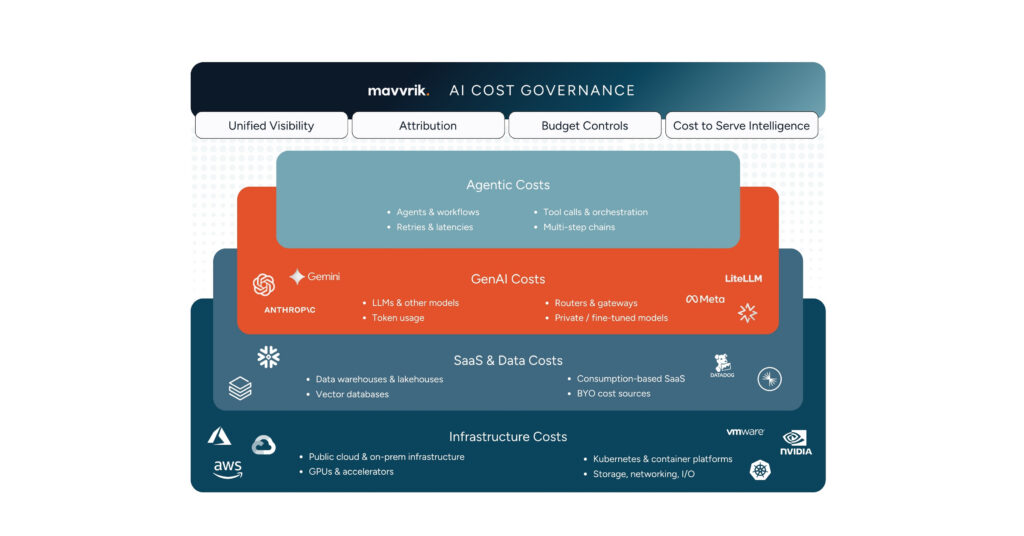
All of it is tracked, connected, and attributed in one system.
So instead of asking why a bill is high, you can answer what is driving it and whether it is worth it.
Common AI Cost Governance Use Cases
We are seeing three areas where this shows up first.
- AI pricing and margins: If you are building AI into your product, you need to know your cost to serve. Without that, pricing is guesswork and margins erode quickly.
- Pilot to production decisions: Before scaling an agent or AI workflow, teams need to answer a simple question. What will this cost at scale? Not just model spend, but the full cost of delivering an outcome.
- Code assist and developer tooling: Tools like GitHub Copilot and Claude Code are everywhere, but most teams cannot tie usage back to value. You end up paying for licenses without understanding adoption or impact.
Available Now
As AI spend continues to increase, end-of-month bills are no longer enough. By the time they arrive, the spend has already happened, and it is not always clear what drove it.
Mavvrik gives teams a way to get ahead of that. It connects cost to teams, products, and outcomes, so you can understand what is happening and act before it shows up on the bill.
Full Stack AI Cost Governance is available today, including agent-level cost tracking through Mavvrik’s Agent SDK. The platform is SaaS-delivered, quick to deploy, and available directly, through partners, and on Google Cloud Marketplace.