


Key takeaways:
- Claude Code and Claude Cowork spend is driven by activity, not just seats. Sessions, prompts, model choices, context size, tool calls, retries, and workflow complexity all shape the bill.
- Mavvrik combines Claude Analytics APIs with OpenTelemetry data, so teams can connect Claude spend to the session-level activity that created it.
- Engineering, FinOps, and finance teams can analyze Claude spend by user, team, session, model, operation, LLM calls, and tool calls, then use that data for allocation, anomaly review, and governance.
Best for: This feature is built for engineering leaders, platform teams, FinOps practitioners, and finance teams managing Claude Code or Claude Cowork usage across developer workflows, SDLC activity, business operations, and shared AI budgets. It is especially useful when Claude adoption is growing, but the cost reporting around it is still stuck at the invoice level.
Claude Spend is No Longer a Black Box
Claude Code and Claude Cowork have moved from interesting tools to daily work surfaces, and the bill now reflects that shift.
Engineering teams use Claude Code to write, refactor, debug, review, and work across codebases. Business teams use Claude Cowork to research, analyze documents, summarize information, and run operational workflows.
That adoption is valuable. It also creates a cost pattern traditional SaaS reporting cannot explain.
Claude spend does not scale like a normal software subscription. It is driven by activity: sessions, prompts, models, token volume, context size, tool calls, latency, errors, retries, and workflow complexity.
The invoice shows how much was spent, but it does not explain why.
Mavvrik now gives teams a way to connect Claude spend to the work that created it, across Claude Code and Claude Cowork.
Why Claude Costs Behave Differently
AI-assisted work does not create clean cost lines. A short Claude Code session might help a developer fix a test in minutes. Another session might pull in a large codebase, use a higher-cost model, call tools repeatedly, hit errors, and retry several times before the task is complete.
Those two sessions may sit under the same user, the same tool, and the same monthly bill. However, they do not create the same cost profile.
It’s become increasingly clear that Claude Code is becoming part of the SDLC. The spend is tied to developer workflows, engineering velocity, and product delivery. If cost is only reviewed at the end of the month, engineering leaders are left guessing which usage patterns are healthy and which ones need a closer look.
Finance has a different problem. It needs to understand who owns the spend, where it belongs, and whether it should be allocated to a team, product, cost center, or business unit.
FinOps sits between the two, trying to connect usage data with financial accountability and that work gets messy when Claude spend lands as one shared AI bucket.
Mavvrik Connects Cost Data With Activity Data
Mavvrik combines two sources of Claude spend intelligence:
- Claude Analytics APIs provide cost, usage, and aggregate activity data.
- OpenTelemetry from Claude Code and Claude Cowork provides session-level activity, traces, spans, tool usage, latency, errors, and operational context.
The APIs show what Claude cost, while OpenTelemetry shows what Claude did.
Mavvrik connects both into an attribution and governance layer, so teams can analyze Claude spend across the dimensions inside engineering and business workflows.
Mavvrik is the first financial control plane to combine Claude Analytics cost data with OpenTelemetry session activity, giving teams a clear path from Claude spend to the users, sessions, models, and workflows behind it.
Provider reporting and observability dashboards can show usage, but finance-ready governance requires allocation, ownership, investigation, and accountability across the same cost model.
With Mavvrik, teams can analyze Claude spend by:
- User
- Team
- Product
- Session
- Model
- Operation
- LLM calls
- Tool calls
- Token type
- Duration
- Latency
- Error state
- Trace ID
- Span ID
This gives engineering, FinOps, finance, platform, governance, and executive teams a shared cost picture with enough detail to investigate, allocate, and act.
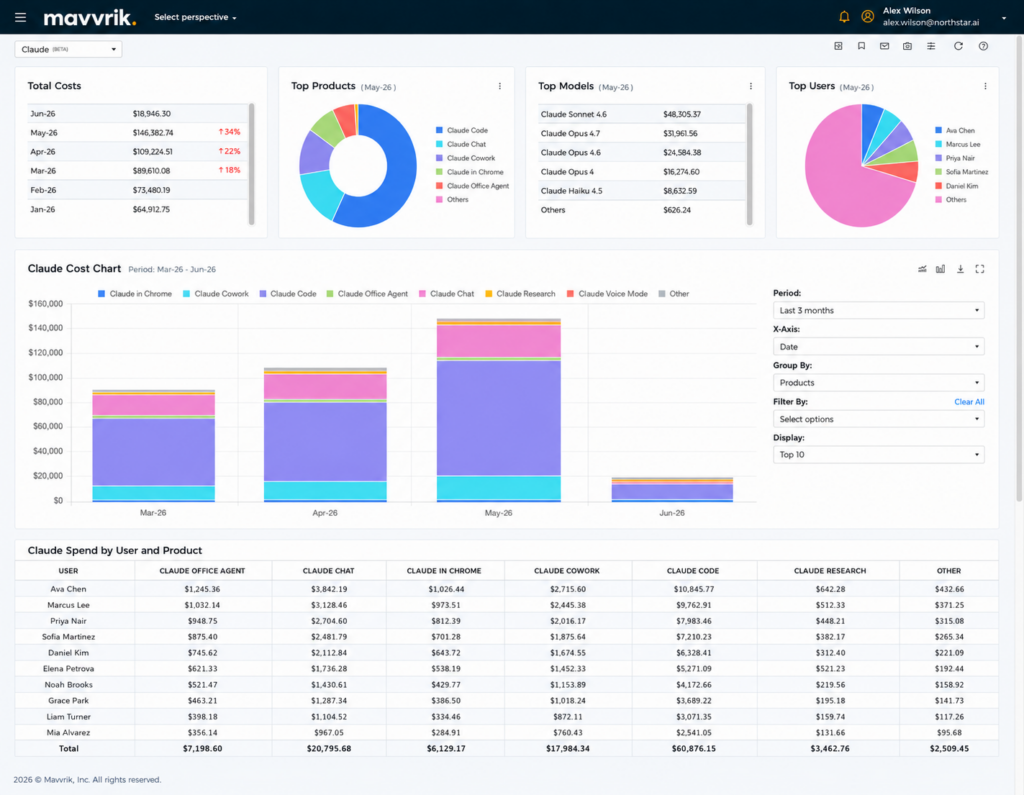
Image: Claude spend by User and Product
Session-Level Attribution is Where the Explanation Lives
Aggregate reporting can show that a team spent more on Claude this week than last week. That is helpful, but it does not tell anyone where to look next.
Session-level attribution gives teams the path.
A weekly report might show:
“Alex spent $350 on Claude Code this week.”
That number alone is not enough.
Session-level attribution can show:
“Most of Alex’s spend came from three long-running sessions using a higher-cost model, large context windows, many tool calls, and repeated retries.”
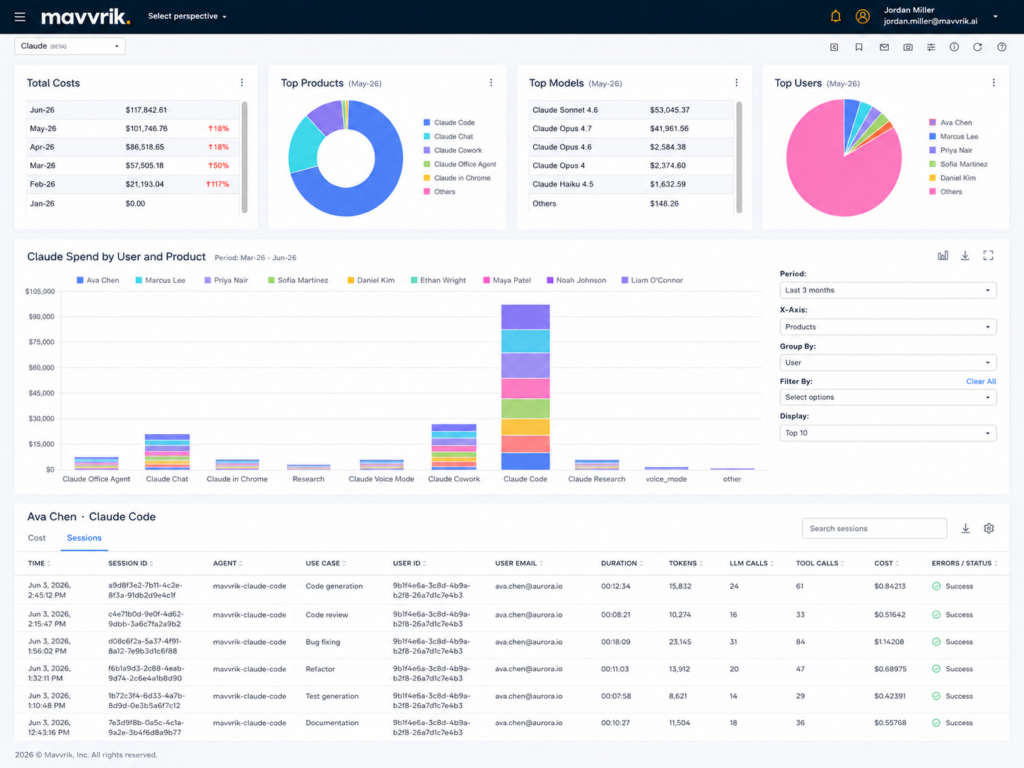
Image: User and Product Drilldown with Sessions.
That difference changes the conversation.
Engineering can review whether the work justified the spend and FinOps can explain the anomaly. Finance can understand whether the cost belongs to a team, product, or cost center. Managers can coach usage with evidence instead of instinct.
Maybe the model choice made sense. Maybe the session was complex and valuable. Maybe the retry pattern was doing nothing useful. The point is that the team can see the difference.
The user owns the access and the session creates the cost.
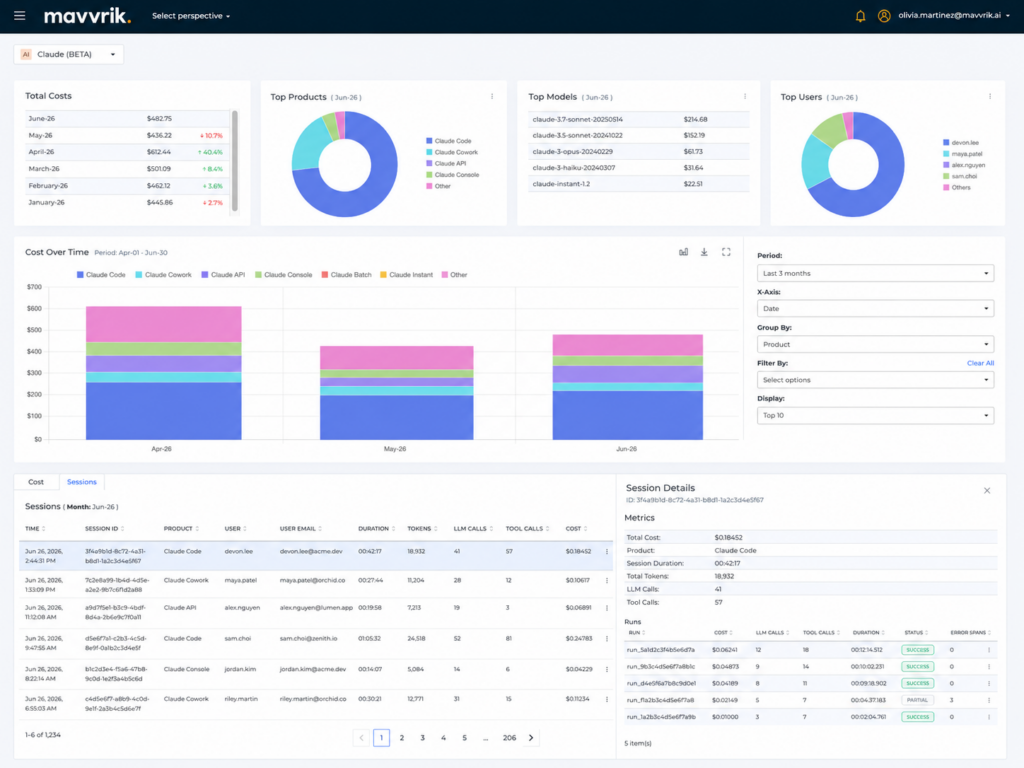
Image: Session details and runs.
What Engineering Leaders Can See
Engineering leaders want Claude adoption to grow, but they also need to know whether usage is efficient, healthy, and aligned with the work their teams are doing.
Mavvrik helps them understand adoption trends, high-cost users, long-running sessions, model mix, and spend by team.
That helps answer practical questions:
- Which teams are using Claude Code the most?
- Which sessions are unusually expensive?
- Are costs concentrated in a few users or spread across normal usage?
- Are retries, errors, or long-running sessions driving avoidable spend?
- Are higher-cost models being used for the right work?
The goal is to use AI more effectively.
What FinOps and Finance Can Use
FinOps teams already manage variable spend across cloud, SaaS, Kubernetes, GPUs, and GenAI APIs. Claude Code and Claude Cowork belong in that same operating model.
Mavvrik helps FinOps and finance teams understand:
- Which users, teams, products, models, and cost centers own Claude spend
- Which sessions explain spikes or anomalies
- Which costs remain unallocated
- Which usage patterns should inform budgets and forecasts
- Which spend should support showback or chargeback
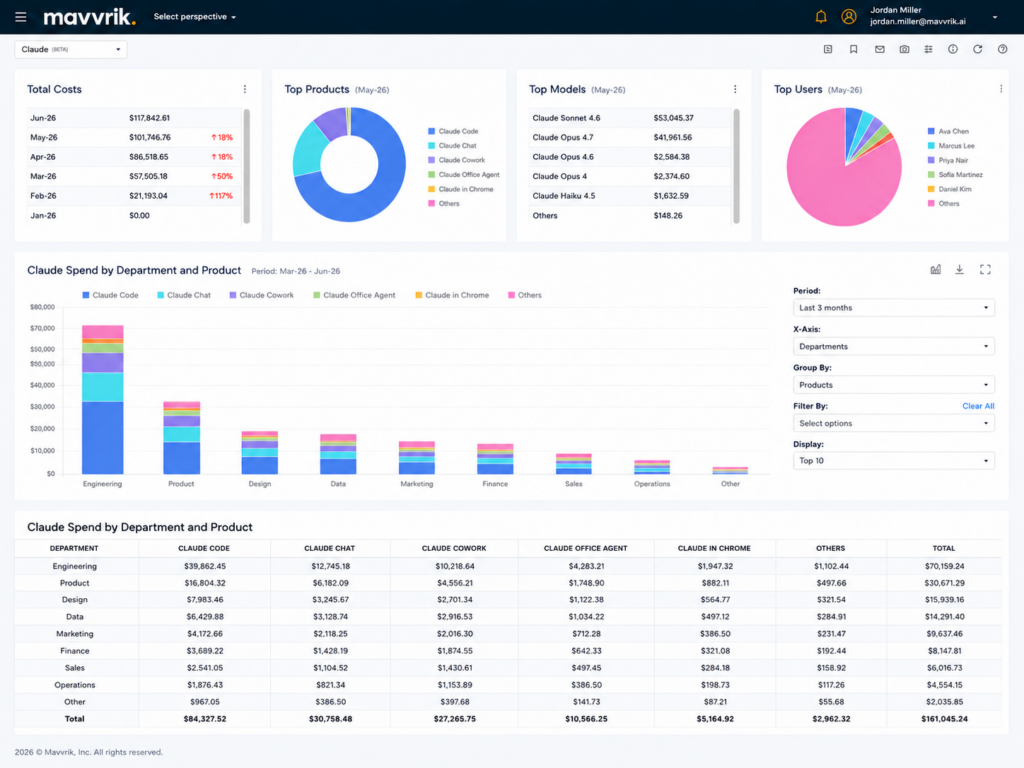
Image: Claude Spend by Department and Product
The Claude Analytics APIs provide the cost foundation. OpenTelemetry provides the activity trail. Mavvrik provides the allocation workflow.
Together, that gives teams a cleaner way to govern Claude spend without turning AI-assisted work into a monthly spreadsheet exercise.
Setup is Managed at the Organization Level
Mavvrik’s Claude integration is configured at the organization level, so individual users do not need separate setup inside Mavvrik.
The process is straightforward:
- Register Claude Code or Claude Cowork in Mavvrik.
- Connect the Claude Analytics APIs.
- Configure Claude telemetry to send OpenTelemetry data to Mavvrik.
- Verify that cost and activity data are flowing.
- Start analyzing spend by user, session, model, token type, and activity.
There is no per-user setup, no separate telemetry pipeline to maintain, and no custom instrumentation project hiding behind the word “integration.”
What Comes Next
This release gives teams immediate visibility into Claude spend and usage across AI-assisted development and business workflows.
Next, Mavvrik will support deeper engineering and business attribution, including:
- Repo attribution
- Team and cost-center mapping
- Commits
- PR activity
- Attempted lines of code
- Accepted and rejected edits
- Cost per PR
- Cost per LOC
That is where Claude spend starts to connect more directly to SDLC economics: what the work cost, where it happened, and how it relates to engineering activity.
How Mavvrik Approaches Claude Spend Visibility
Mavvrik treats Claude Code and Claude Cowork spend as part of the broader AI cost governance problem: usage is distributed, cost is variable, and ownership needs to be clear before teams can make good decisions.
In practice, that means three things:
- Mavvrik connects Claude cost data with session-level activity, so teams can explain spend with operational context instead of relying on invoice totals.
- Mavvrik attributes Claude usage across users, teams, sessions, models, operations, LLM calls, and tool calls, so engineering and finance can work from the same cost logic.
- Mavvrik brings Claude spend into the same governance model as cloud, SaaS, Kubernetes, GPUs, LLMs, and agentic workloads, so showback, chargeback, forecasting, anomaly review, and budget controls do not live in separate processes.
If Claude Code or Claude Cowork spend is already showing up in budget reviews, request access to the feature and start with the first question that matters: which work created the cost?
FAQ
What does Mavvrik’s Claude Cowork and Code feature do?
It attributes Claude Code and Claude Cowork spend across users, teams, sessions, models, token types, operations, LLM calls, tool calls, latency, errors, traces, and related activity signals.
Where does the cost data come from?
Cost and aggregate usage data come from Claude Analytics APIs.
Where does the activity data come from?
Session-level activity comes from Claude Code and Claude Cowork telemetry sent to Mavvrik through OpenTelemetry.
Why does Mavvrik need both APIs and OpenTelemetry?
The APIs provide the cost foundation. OpenTelemetry provides the session-level activity needed to understand what happened inside the workflow. Mavvrik combines both so teams can connect spend to behavior.
Does every user need to configure anything?
No. The integration is configured at the organization level. Individual users do not need separate Mavvrik setup.
Does Mavvrik replace Claude billing?
No. Claude remains the billing source. Mavvrik adds attribution, investigation, allocation, and governance on top of Claude spend.

Alexa Abbruscato
Certified FinOps Practitioner & Content Strategist
Alexa is a certified FinOps Practitioner and FOCUS Analyst who translates complex concepts into language that resonates across engineering, finance, and procurement.