
AI cost tracking is now common, however, accurate forecasting is still rare. Mavvrik’s State of AI Cost Governance 2026 Report shows that 98% of organizations track AI infrastructure costs, 95% assign formal AI budgets, and only 11% forecast AI spend within ±10%.
That tells the story at the center of the report: AI spend is visible enough to appear in budgets, but the cost picture is still too incomplete to support confident forecasting, pricing, margin review, and ROI analysis.
Key takeaways:
- 98% of organizations track AI infrastructure costs and 95% assign formal AI budgets, yet only 11% forecast AI spend within ±10%.
- Unexpected AI costs have moved into operating decisions, with 62% of organizations reporting that cost surprises altered a business decision in the past year.
- AI cost visibility drops as spend moves beyond structured billing data into agents, GPUs, developer tools, data platforms, and private infrastructure.
- Agentic AI reached near-universal adoption before cost attribution caught up, with 98% running agentic workloads and only 36% including them in cost reporting.
- AI cost governance now sits across finance, technology, product, FinOps, and engineering because AI spend affects margin, architecture, pricing, attribution, and workflow design at the same time.
Best For: CFO / Finance Leader | CIO / CTO | FinOps / CloudOps Leader | Head of Product / Chief AI Officer | Engineering Leader
What the Report Covers
Mavvrik’s State of AI Cost Governance 2026 Report conducted with Benchmarkit and Ray Rike, surveyed 396 organizations across six sectors during April and May 2026.
The report examines how organizations are managing AI spend across seven areas:
- AI cost governance
- Agentic AI
- Cost visibility and attribution
- Financial impact
- Cloud and AI infrastructure
- Developer tooling and the SDLC cost footprint
- Industry-level AI cost patterns
The 2026 findings show that AI cost management has moved past the early “who owns the bill?” stage. AI spend now shows up in pricing decisions, gross margin reviews, infrastructure planning, product packaging, board conversations, and roadmap tradeoffs.
The harder problem is coverage.
Cloud bills and model invoices explain part of the cost. AI workloads now touch a wider stack: hosted LLMs, data platforms, public cloud, private infrastructure, GPUs, agentic workflows, AI developer tools, and SaaS services with embedded AI. A partial view can still look organized. It can still miss the forecast.
What Changed Since the 2025 Report
The 2025 research found that AI costs were already affecting margins, while visibility and forecasting remained weak. Eighty-five percent of respondents missed their AI cost forecasts by more than 10 percent, only 35 percent included on-premises costs in reporting, and many still lacked a reliable view of AI cost-to-serve.
In 2026, tracking and budgeting are more established, but the cost surface has expanded. This year’s research also looks across the software development lifecycle, where coding assistants and AI-enabled developer workflows add new layers of usage and spend. Alongside agentic workflows, data platforms, GPUs, and private infrastructure, that makes attribution more important. The harder question now is whether each cost can be connected to the customer, product, workflow, model, team, and decision behind it.
Read the 2025 State of AI Cost Governance Report for the previous benchmark
AI Budgets Are Common. Accurate Forecasts Are Not.
The report’s headline finding: organizations have put AI into the budget process, but the budget process has not caught up to how AI costs behave.
98% of organizations track AI infrastructure costs. 95% assign formal AI budgets. Only 11% forecast AI spend within ±10%.
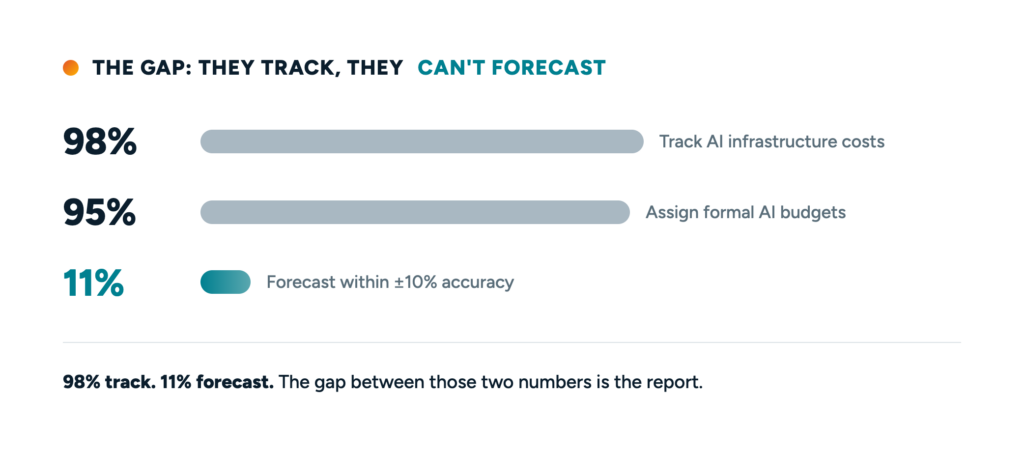
Forecast accuracy also declined from 2025, even as tracking and budgeting became more common. This suggests that the challenge is not awareness of AI spend. It is reporting coverage across the cost categories that change most quickly including agents, GPU infrastructure, developer tools, private environments, and data platform activity tied to AI workloads.
Tracking is necessary but it is not sufficient. AI cost governance requires spend to be connected to the product, customer, team, workflow, agent, model, environment, and business decision behind it.
AI Cost Surprises Are Now Business Events
AI cost surprises are no longer staying inside cost management reviews.
In the past year, 62% of organizations say unexpected AI costs materially altered a business decision in the past year. The consequences included forced repricing, executive or board-level escalation, emergency spending freezes, retroactive budget reallocations, and delayed or cancelled initiatives.
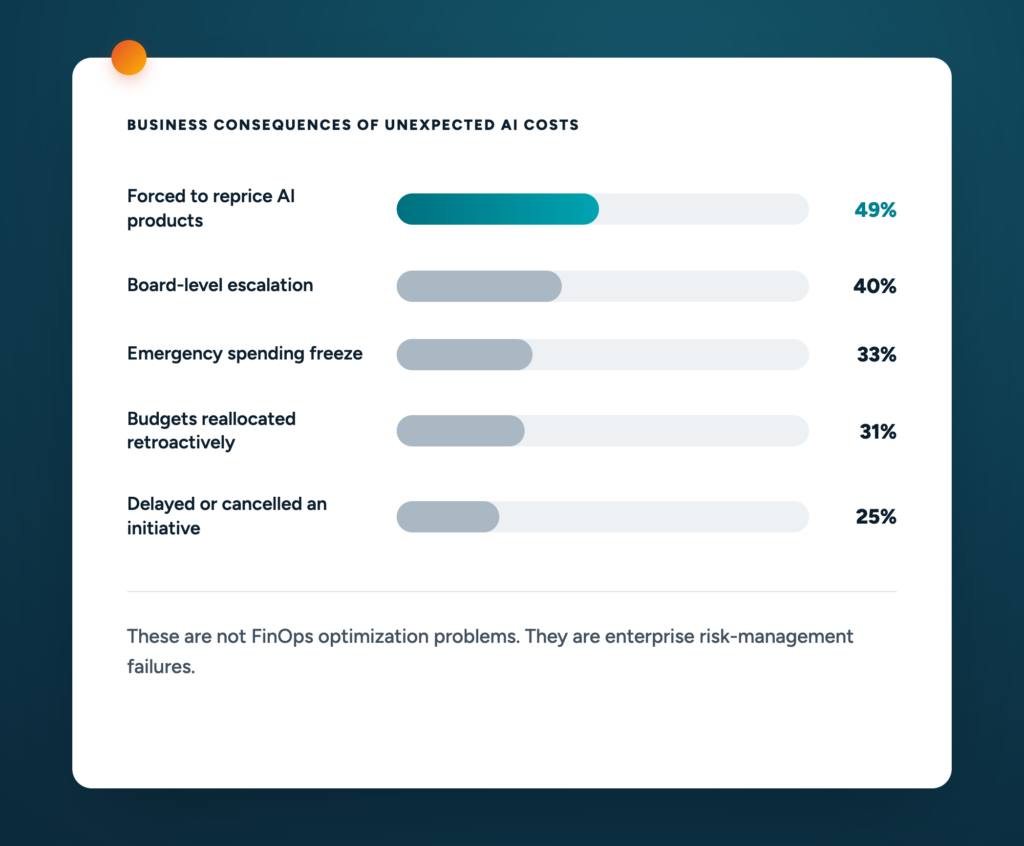
The consequence is clear: AI spend can move quickly from a technical variance to a business exposure. When the cost of an AI feature, workflow, or agent becomes unpredictable, the impact reaches product economics, investment plans, customer commitments, and operating margins.
Agentic AI Is Running Ahead of Cost Reporting
Agentic AI is one of the clearest signs that AI cost governance needs to move beyond traditional cloud and SaaS reporting.
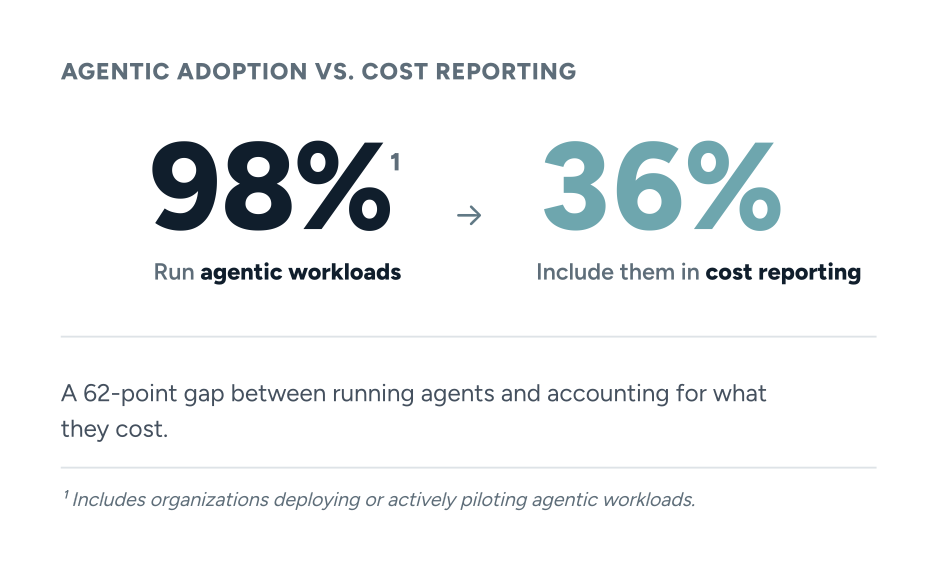
Agents create cost in a different pattern than standard software or straightforward model calls. A single task can trigger multiple model calls, retrieval steps, data platform queries, tool actions, retries, and orchestration overhead. Two runs of the same workflow can therefore have very different costs.
That makes agentic cost harder to forecast from seat counts, fixed budgets, or simple request volume.
Agentic AI needs attribution at the workflow, session, model, agent, and task level. Without that, teams may know an agent is being used, while still missing which workflows are expensive, which agents are efficient, and which customer or internal use cases are changing the economics.
The AI Cost Stack Is Wider Than Tokens
LLM token costs remain a major cost category, but they are also only one part of the AI bill.
The report found that data platform usage overages were the top source of unexpected AI costs at 47%, ahead of LLM token costs at 43%.
That finding reflects how AI systems operate in production. AI features pull context, search data, run retrieval, refresh pipelines, call tools, trigger evaluations, and query data platforms. Those surrounding costs often sit outside the first AI budget review because the model bill is easier to see.
Developer AI is also becoming a material cost surface
98% of organizations use AI coding tools, with an average of 2.4 tools per organization. Only 42% include AI developer tools in AI cost reporting, and 39% report costs exceeding expected license or usage.
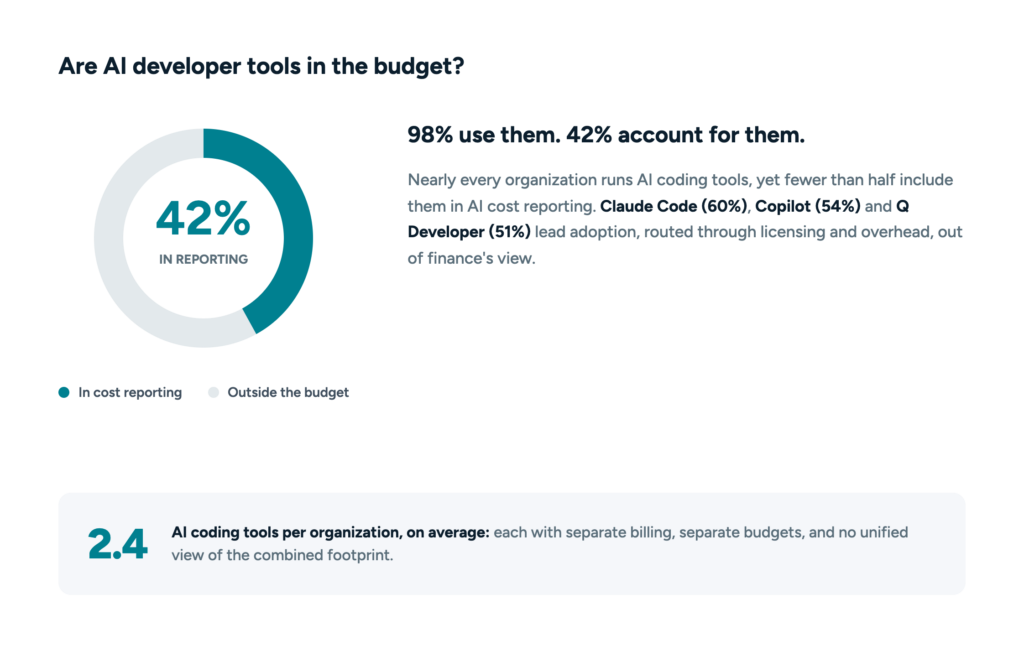
For engineering and FinOps leaders, developer AI is becoming a cost surface of its own. The footprint is no longer limited to a license line. As agentic coding workflows expand, AI tools will increasingly affect compute, CI/CD activity, review workflows, and engineering operating costs.
Hybrid AI Makes Cost Visibility Harder to Centralize
68% of organizations in the report run hybrid AI workloads.
Hybrid AI can be the right technical model because it supports data residency, performance, latency, security, vendor flexibility, and workload-specific infrastructure decisions.
However, it also makes cost governance harder. A hybrid AI environment can include public cloud, hosted LLMs, private data centers, on-prem GPU clusters, third-party GPU providers, data platforms, and internal systems with limited billing data. Each layer has its own pricing model, owner, reporting path, and cost signal.
AI cost visibility increasingly has to be built from billing, telemetry, usage data, workflow context, and business attribution together.
Margin, Pricing, and Cost-to-Serve Are Now Part of AI Governance
AI cost governance includes margins in the conversation. The report shows that 81% of organizations report moderate-to-high gross margin impact from AI costs. At the same time, 70% have not required COGS-based AI cost tracking.
That is a dangerous combination for AI-powered products.
When AI is embedded in a product, every inference, generated answer, retrieval step, agent task, and data platform call can affect cost-to-serve. If that cost is measured only against revenue, teams may know AI spend is growing without knowing whether a feature is helping or hurting margin.
The report also found that 67% of organizations track AI cost-to-serve and use it for pricing and margin decisions. Another 23% track cost-to-serve but do not price from it.
Every AI Leader Sees a Different Part of the Same Cost Problem
AI cost governance now touches every function responsible for scaling AI. The priorities differ by role, but the operating goal is shared: AI spend should scale with the outcome it supports.
For CFOs and finance leaders, AI shifts cost review from budget tracking to margin control. Their priority is to require cost-to-serve visibility, COGS-based tracking where AI touches the product, and pre-deployment cost review for material AI investments. The finance question becomes whether an AI feature or workflow can scale without weakening forecast confidence or gross margin.
For CIOs and CTOs, AI shifts infrastructure planning into cost architecture. Hybrid AI, agents, private infrastructure, GPUs, data platforms, and developer tools need cost signals designed into the operating model before usage scales. Their priority is coverage across the full AI stack, including environments where billing data is incomplete or hard to collect.
For FinOps and CloudOps leaders, AI expands the cost perimeter beyond cloud invoices. Their priority is attribution that shows who spent the money and why it cost what it did, with enough detection speed to act before cost becomes a monthly reporting problem. Team and department views help with ownership, but workflow, agent, model, customer, and developer-user views are where optimization starts.
For Heads of Product and Chief AI Officers, AI shifts pricing and packaging closer to unit economics. Their priority is cost-to-serve at the customer, feature, and workflow level before usage scales. Product decisions need to account for the cost of generated answers, retrieval, agent tasks, model routing, and the surrounding systems that support the experience.
For engineering leaders, AI makes cost part of system design. Model selection, context management, retry logic, orchestration design, GPU utilization, tool access, and data access patterns all affect spend before it reaches finance teams. Their priority is to build cost telemetry into AI systems early, so teams can see which design choices are driving cost while those choices can still be changed.
Start With Coverage, Not Another Dashboard
The report makes one thing clear: AI cost governance does not start with another executive dashboard. It starts with coverage and attribution that match how AI is used.
A practical starting point looks like this:
- Map the full AI cost surface. Include cloud, hosted models, data platforms, GPUs, private infrastructure, agents, developer tools, and AI-related SaaS.
- Identify which costs are missing from current reporting. Pay close attention to environments with weak billing data or spend routed through software, overhead, or shared infrastructure.
- Assign owners at the level where decisions happen. Department-level ownership helps with accountability, but workflow, product, customer, model, and agent-level ownership help teams act.
- Track unit costs. Use cost per customer interaction, inference, workflow, agent run, coding tool user, GPU job, or successful task, depending on the use case.
- Reduce detection lag. AI costs driven by consumption and runtime behavior should be visible before monthly reporting turns them into a budget story.
Key Insight: The next stage of AI cost governance is about seeing enough of the cost chain to make better decisions before spend outruns value.
Why Download the Full Report
This overview covers the report’s main findings, but the full 2026 State of AI Cost Governance Report goes deeper into the data behind each area of AI cost governance.
The full report provides the benchmark data, segment analysis, and operating guidance behind that conclusion. Download it to explore:
- The full forecast accuracy distribution
- AI cost ownership patterns across finance, engineering, FinOps, and product
- Agentic AI adoption, reporting coverage, and attribution levels
- Unexpected cost sources across data platforms, tokens, coding tools, egress, GPUs, and agent retries
- Gross margin impact and business consequences from AI cost surprises
- Hybrid, multi-cloud, and third-party AI infrastructure trends
- Developer tooling adoption and the SDLC cost footprint
- Industry-level findings across AI-native, B2B SaaS, financial services, AI infrastructure, manufacturing, and retail
- Role-specific guidance for CFOs, CIOs, CTOs, FinOps leaders, product leaders, AI leaders, and engineering leaders
The report is designed for leaders who need to understand where AI cost governance stands in 2026 and which controls should come next.
How Mavvrik Approaches AI Cost Governance
Mavvrik treats AI cost governance as an attribution and control problem across AI, cloud, SaaS, GPUs, agents, data platforms, developer tools, and hybrid infrastructure.
The platform connects spend to the business and technical context leaders need: product, feature, customer, team, model, provider, agent, workflow, developer user, environment, and usage pattern.
Three ways to continue from here:
- Download the 2026 State of AI Cost Governance Report to benchmark your AI cost visibility, forecasting, and attribution maturity.
- Review how your current reporting compares to a full-stack AI cost governance model, including AI, cloud, SaaS, GPUs, agents, data platforms, developer tools, and hybrid infrastructure.
- See how Mavvrik connects AI, cloud, agent, GPU, developer tool, and hybrid infrastructure spend in the product tour.
FAQs
What is the 2026 State of AI Cost Governance Report?
The 2026 State of AI Cost Governance Report is a Mavvrik research report, conducted with Benchmarkit and Ray Rike, based on 396 organizations surveyed across six sectors during April and May 2026. It examines how organizations track, forecast, attribute, and govern AI costs across cloud, data platforms, agents, GPUs, developer tools, and hybrid infrastructure.
What is AI cost governance?
AI cost governance is the practice of tracking, attributing, forecasting, and controlling AI spend across the full stack. It connects AI costs to owners, products, customers, workflows, models, agents, environments, and business decisions.
Why can an organization track AI costs and still miss the forecast?
Tracking may only cover the easiest cost sources, such as public cloud or LLM invoices. Forecasting needs coverage across the full AI cost base, including agents, GPUs, data platforms, private infrastructure, developer tools, and runtime behavior.
Are tokens the biggest AI cost driver?
Tokens are a major cost driver, but they were not the top unexpected cost in the 2026 report. Data platform usage overages were cited by 47% of organizations, ahead of LLM token costs at 43%.
Who should read the report?
The report is useful for CFOs, finance leaders, CIOs, CTOs, FinOps and CloudOps leaders, Heads of Product, Chief AI Officers, and engineering leaders responsible for scaling AI while keeping cost, margin, attribution, and business value visible.
Written by:

Lindsey Tishgart
VP of Marketing @ Mavvrik
Lindsey is VP of Marketing at Mavvrik, where she focuses on the growing cost of AI and how enterprises can scale it responsibly. She writes and thinks about AI economics: how unchecked spend creates financial and operational risk, how AI investment connects to margin and ROI, and how finance, engineering, and AI leaders can bring real governance to a problem most companies are still ignoring.