
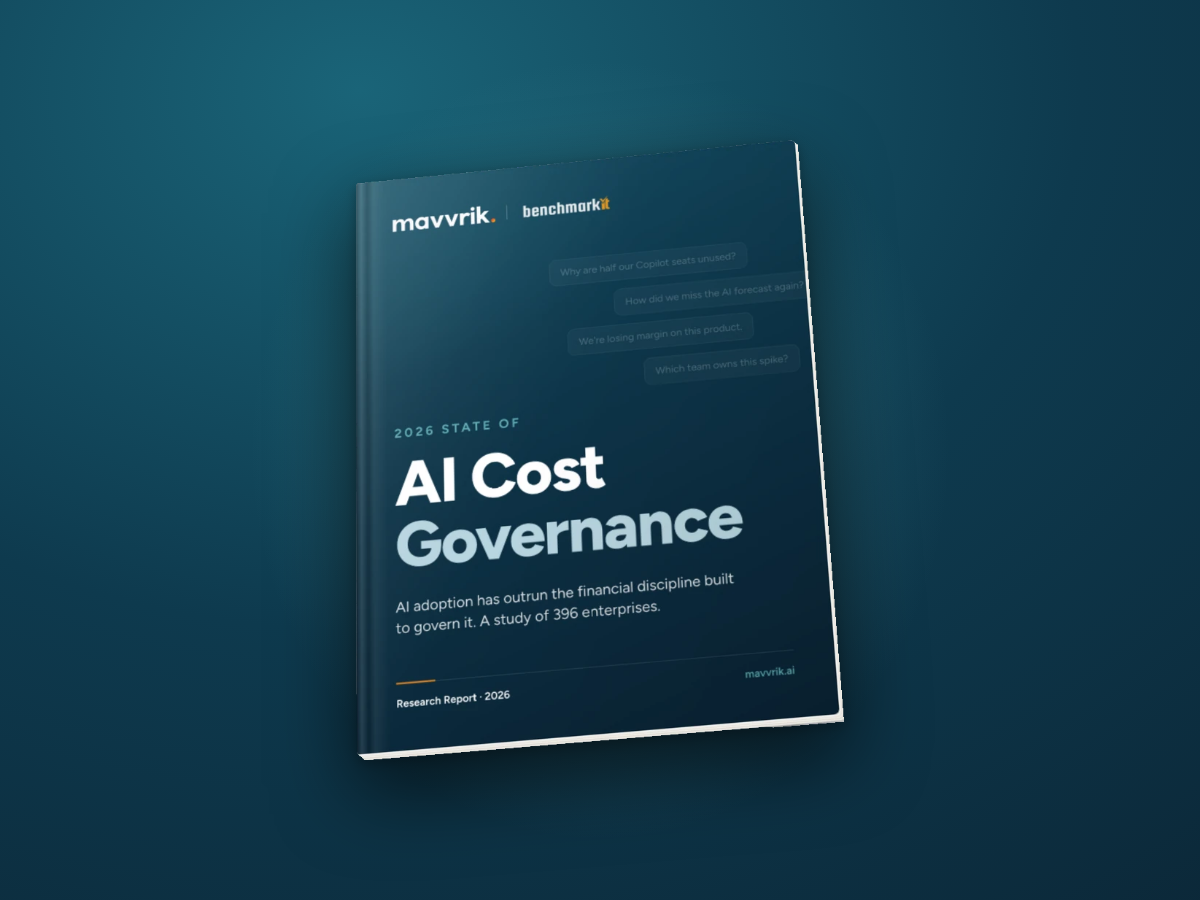
451 Research (S&P Global) examined Mavvrik’s platform, its new Agentic Cost Intelligence SDK, and the Ingram Micro channel partnership. This is what they found.
Read More
AI workloads increase Databricks and Snowflake costs by adding repeated compute, vector search, model serving, embeddings, storage, and inference activity to existing data platforms. This article explains the core AI cost drivers and why FinOps teams need workload-level attribution to measure true AI cost-to-serve.
Read More
AI cost tracking in 2026 requires more than monitoring token spend or reviewing provider invoices. This guide explains how finance, FinOps, and engineering teams can track AI costs across workflows, customers, and environments using metrics like cost per inference, cost per workflow, and cost-to-serve.
Read More
Building AI cost management internally sounds manageable until the integration and maintenance burden becomes clear. This article breaks down the cost, time, and visibility tradeoffs between building in-house and using a purpose-built platform.
Read More
Google Cloud Next 2026 confirmed that AI is no longer experimental infrastructure. As agentic AI adoption accelerates, enterprises are facing new cost challenges tied to token usage, distributed services, cross-cloud architectures, and continuous inference workloads.
Read More
AI cost visibility breaks down when spend is forced into the same monthly reporting model used for cloud infrastructure. This guide covers how to fix it.
Read More
AI infrastructure costs are notoriously difficult to measure because they don’t live in one place. A single AI workload can span GPUs, cloud compute, model APIs, and shared orchestration layers, each producing its own usage and billing signals. Most organizations can see total spend, but not what drives it.
Read More
AI workloads complicate data center cost governance by spanning multiple environments, using heterogeneous compute, and generating costs that cannot be accurately allocated from infrastructure-level signals alone.
Read More
Universities are investing heavily in shared GPU clusters for AI research, but many still lack clear cost visibility. Transparent GPU chargeback enables research computing teams to track usage, allocate costs across labs and grants, and improve financial accountability across complex infrastructure environments.
Read More
AI spending is growing fast, but cost visibility hasn’t kept up. Most teams can’t clearly answer what they spend on AI, which teams drive it, or what it costs to support a feature or customer. Full Stack AI Cost Governance changes that.
Read More
As AI infrastructure scales, GPUs have become a new form of digital currency. The organizations that know how to measure, package, and price their capacity will define the economics of AI operations in 2026 and beyond.
Read More
Organizations can now purchase AI and cloud cost governance through Google Cloud Marketplace. Customers can apply committed Google Cloud spend, use Private Offers, and deploy under standardized commercial terms.
Read More