

FinOps for AI applies FinOps practices to AI spending and value, including allocation, forecasting, optimization, and cost governance. AI for FinOps uses AI to query cost data, investigate anomalies, prepare forecasts, recommend allocation mappings, and automate bounded parts of a cost workflow.
Key takeaways:
- FinOps for AI helps a business understand who is spending on AI, what the spend supports, how it may change, and whether the resulting value justifies the cost.
- AI for FinOps helps a practitioner move through analysis and routine workflow faster. Its output is only as dependable as the cost, usage, ownership, and business context it can access.
- Start with governed cost data and clear allocation. Add AI to narrow, testable tasks before giving an agent permission to change resources or budgets.
- Measure the two directions differently. FinOps for AI should improve allocation, forecast quality, unit economics, and value decisions. AI for FinOps should reduce effort or cycle time without weakening accuracy, auditability, or control.
Best for: FinOps practitioners, finance and engineering leaders, AI platform teams, and anyone accountable for AI spend.
An AI cost appears in the monthly review. Finance can see the invoice. Engineering can explain the model. Nobody can say which product feature, customer, or workflow created the increase. At the same time, the FinOps team is spending hours joining billing files, usage records, and ownership data just to ask the next question.
Those are two different problems with similar names.
The direction matters. One governs the economics of AI. The other changes how FinOps work gets done. A team may need both, and the data foundation comes first.
The distinction is timely. In the State of FinOps 2026, the FinOps Foundation reported that 98 percent of respondents manage AI spend, up from 63 percent in 2025 and 31 percent in 2024. The same report lists both FinOps for AI and AI for FinOps among the practice’s forward-looking priorities. The survey included 1,192 respondents representing more than $83 billion in annual cloud spend.
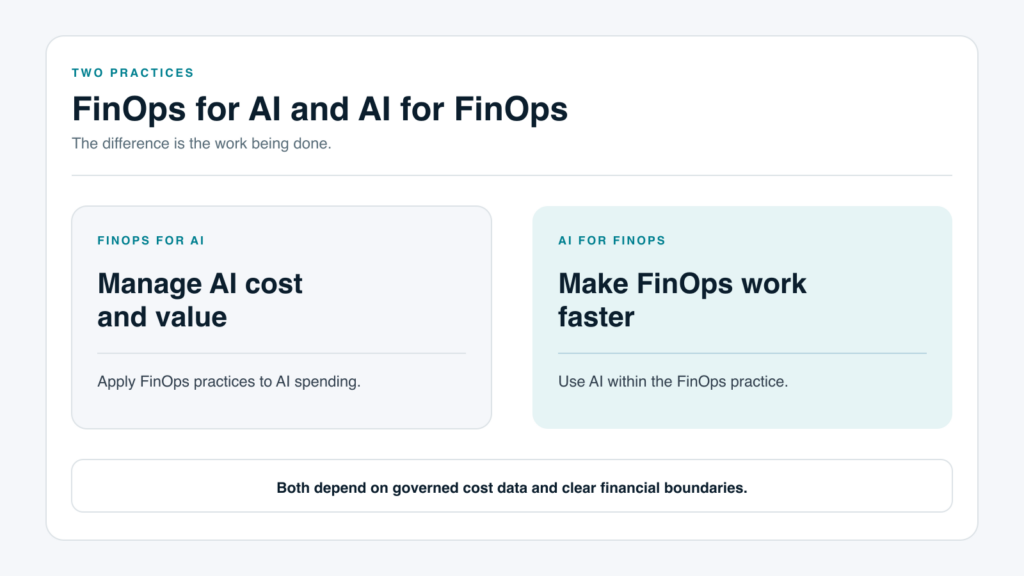
FinOps for AI and AI for FinOps, defined
The FinOps Framework describes FinOps as an operational framework and cultural practice that maximizes the business value of technology. Its current technology categories include public cloud, SaaS, data center, data cloud platforms, and AI.
The Foundation’s FinOps for AI technology category focuses on AI cost complexity, faster development cycles, unpredictable spend, and the need for policy and governance that still supports innovation. It applies familiar FinOps capabilities to a cost surface that can cross model providers, cloud accounts, data centers, SaaS tools, data platforms, and specialized infrastructure.
The Foundation also maintains a dedicated AI for FinOps topic. It describes AI as a way to make the practice faster, more accurate, and more scalable, with early use cases in anomaly detection, recommendations, natural-language analysis, allocation, and procurement workflows.
| Question | FinOps for AI | AI for FinOps |
|---|---|---|
| What is being managed? | AI cost, usage, value, and financial accountability | FinOps analysis, decisions, and workflow |
| What data is needed? | Billing, usage, telemetry, ownership, workload, and business outcome data | Governed FinOps data plus policy, history, context, and permissions |
| Who is accountable? | FinOps, finance, engineering, product, procurement, and business owners | The practitioner and process owner using or supervising the AI |
| What does success look like? | Better attribution, forecasts, unit economics, decisions, and spend control | Faster work with acceptable accuracy, traceability, and review effort |
| What is the main failure mode? | Managing totals without connecting cost to an owner, workload, or value unit | Automating analysis on incomplete data or allowing action beyond approved boundaries |
These directions reinforce each other. They should still be planned and measured as separate workstreams.
Where are you on the AI FinOps maturity curve?
The Foundation’s Crawl, Walk, Run maturity model applies to individual capabilities. It is not a single score for the whole practice, and Run is not the required destination for every process. Business value determines where added maturity is worth the effort.
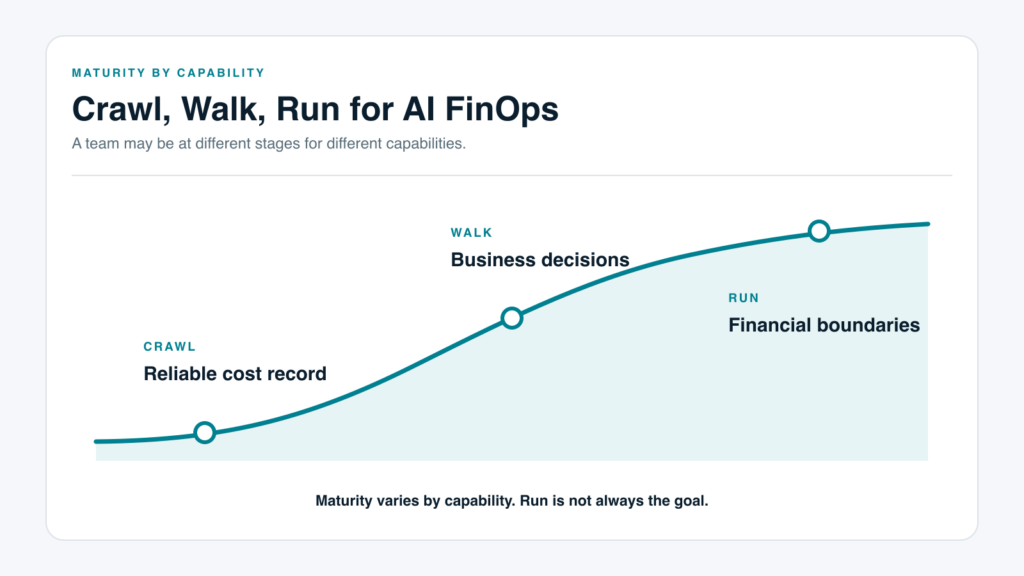
Crawl: establish a cost trail
At Crawl, the job is to make AI costs visible enough to assign responsibility and ask useful questions. Define the AI scope, identify material data sources, name an owner, and choose one operating unit such as cost per inference, cost per workflow, or cost per customer interaction.
An AI for FinOps use case at this stage should stay narrow. A natural-language interface might summarize a known cost view or help a practitioner draft an investigation query. The practitioner checks the source records before using the answer.
Walk: connect cost to decisions
At Walk, teams allocate shared model, GPU, data, and platform costs through repeatable rules. Forecasts are revised as pilots change. Showback gives engineering and product owners a chance to validate the model. Unit costs begin to appear beside service quality or business outcome measures.
AI can help rank anomalies, suggest missing ownership mappings, create variance explanations, and prepare scenario inputs. Human review remains part of the workflow, especially when a recommendation would change a commitment, budget, price, or production resource.
Run: automate within explicit financial boundaries
At Run, cost and usage data are tied to products, customers, features, or other units of value. Policies operate close to the decision point. The practice can compare AI investments using consistent economic measures and can explain material movements without rebuilding the analysis each month.
Agentic FinOps can investigate, recommend, route work, and execute approved actions within defined permissions. A mature setup records the data used, the policy applied, the proposed or completed action, the owner, and the result. Higher maturity raises the standard for evidence and control.
How AI reshapes FinOps capabilities
AI adds cost units, technical layers, vendors, and purchasing models. The FinOps capabilities still apply, with different data and operating detail. The following comparison adapts the FinOps for AI technology category by the FinOps Foundation under CC BY 4.0.
| FinOps capability | How AI changes the work | Practical move |
|---|---|---|
| Data ingestion and reporting | Cost can sit across provider bills, model usage, GPUs, data platforms, cloud, on-premises systems, SaaS, and orchestration. Business context often lives elsewhere. | Start with one production workflow and document the join from usage to billed cost to owner. See how to track AI costs. |
| Allocation | A shared model or agent can serve several features, teams, or customers. Multi-agent paths make the original consumer harder to trace. | Capture ownership and workflow context at the request or run level, then define shared-cost rules. Validate them through showback before chargeback. |
| Forecasting and budgeting | New workloads have limited history, variable demand, changing architectures, and mixed pricing units. Forecasts need shorter review cycles. | Build from workload drivers and planned events. Keep a range for uncertain demand and revise it as the workload moves from pilot to production. |
| Unit economics | Tokens and inference requests are useful usage measures, though neither captures the full cost or business outcome on its own. | Pair cost per inference or workflow with an outcome measure that fits the service. Use cost-to-serve when the decision is about a product, feature, or customer. |
| Anomaly management | Experimentation, concurrency, retries, and fast changes can create volatile patterns. An aggregate alert may hide the responsible model, run, or owner. | Detect at the lowest dependable allocation level, then route the investigation to someone who can explain and change the usage. |
| Rate and usage optimization | Teams may choose among on-demand model APIs, reserved capacity, specialized GPU commitments, self-hosted models, and routing strategies. | Separate price, volume, mix, allocation, and timing effects before deciding that a rate or architecture change will lower total cost. |
| Policy and governance | Experiments need room to learn, while production workloads need cost thresholds, owners, and escalation paths. | Tie controls to spend, budget, forecast, or unit-cost conditions. Review training and inference controls separately because their cost behavior differs. |
A small AI cost metric set
The Foundation lists several AI-specific measures. Three are useful starting points:
- Cost per inference: total inference cost divided by the number of inference requests.
- Cost per token: total cost divided by the number of tokens used. Define which costs and token types are included.
- Resource utilization efficiency: actual resource utilization divided by provisioned capacity.
A denominator creates a unit cost. It does not prove value. Pair the financial measure with the outcome the workload is expected to produce, such as resolved cases, accepted recommendations, completed workflows, revenue, or service quality.
AI for FinOps: where it can help
AI for FinOps is useful when the work is data-heavy, repetitive, and testable. The model or agent needs access to governed source data, clear definitions, and enough context to distinguish a cost movement from a business event. The practitioner remains responsible for the conclusion and the action.
Anomaly detection and investigation
AI can compare current usage and cost with historical patterns, seasonality, workload context, and planned events. The useful output is a ranked investigation with the likely cost contributors and responsible owner, rather than another alert that says spend increased.
Composite practitioner example: A token-cost spike appears after a product release. A static threshold can flag the increase. An AI-assisted workflow can also check whether request volume changed, output length increased, retries rose, model mix shifted, or the new feature changed routing. The practitioner still decides whether the movement is expected, wasteful, or worth the added cost.
Measure this use case through detection quality, investigation time, false-positive rate, and the share of alerts that reach an accountable owner with enough evidence to act.
Predictive forecasting and scenario work
AI can help assemble forecasts from history, planned launches, price changes, usage drivers, and engineering assumptions. It can also generate scenarios quickly: a demand increase, a model switch, a capacity commitment, or a change in average tokens per request.
The hard part is still the premise. A model trained on a pilot will not know that a product launch changes user behavior unless the plan is included. Price changes, new architectures, and new business units can break the pattern. Forecast output should show assumptions, ranges, and variance drivers so finance and engineering can challenge them.
Evaluate the forecast at the level where a decision is made. Total AI spend may be on plan while one product’s cost per successful outcome is moving in the wrong direction.
Plain-language cost analysis
Generative AI can turn a cost question into a query and return an explanation in the language of the reader. Finance may ask why the forecast moved. Engineering may ask which model or workflow drove the change. Both questions should resolve to the same governed records and allocation logic.
This is a strong early use case because the action can remain read-only. It also exposes weaknesses in the data model quickly. If the system cannot define cost, owner, time range, allocation rule, or comparison period, a fluent answer will hide the uncertainty.
Require the answer to show its filters, source period, cost basis, and material contributors. A practitioner should be able to reproduce the result without trusting the prose.
Allocation and metadata assistance
AI can suggest owners, tags, categories, or shared-cost mappings from account names, resource metadata, deployment records, repositories, and earlier decisions. This can reduce manual classification work and surface inconsistent conventions.
Treat the suggestion as a proposed mapping until an accountable owner approves it. Allocation changes affect showback, chargeback, margin, and budgets. The system should retain the prior rule, the evidence for the change, and the effective date.
Agentic FinOps
Agentic FinOps extends analysis into a sequence of tool-using steps. An agent might investigate an anomaly, find the resource owner, prepare evidence, open a work item, and recommend a rightsizing or scheduling change. The FinOps Foundation describes practitioners experimenting with this kind of autonomous investigation and routing in its agentic use-case guidance.
Begin with read access and recommendation-only behavior. Add action permissions by workflow, with explicit financial thresholds, approval rules, audit records, and rollback paths. A low-risk idle development resource can have a different policy from a production GPU pool or a commitment purchase.
An agent should earn broader authority through measured performance. Track recommendation acceptance, realized outcome, reversals, policy exceptions, and the cost of running the agent itself.
Why the two directions need each other
FinOps for AI produces the data and accountability that AI for FinOps needs. A model can investigate a cost increase more effectively when usage is tied to a model, workflow, owner, and business unit. An agent can recommend a budget action more safely when the budget, forecast, approval policy, and cost basis are explicit.
AI for FinOps can improve that foundation in return. It can find missing ownership, flag inconsistent allocation, shorten anomaly investigation, and expose where a forecast needs a new driver. Each reviewed result becomes feedback for the data model and the process.
The loop fails when fluent analysis outruns the ledger. AI cannot repair an undefined unit of cost, an absent owner, or a disputed shared-cost rule through explanation alone.
How to put both into practice
- Define the AI scope. List the workloads, providers, infrastructure, data services, SaaS tools, and shared platforms that belong in the decision.
- Build the cost trail. Connect usage to billed or modeled cost, then add owner, product, customer, workflow, and environment context at the lowest dependable level.
- Choose decision metrics. Use a small set of totals, unit costs, forecast measures, and value outcomes. Record what each numerator and denominator includes.
- Apply AI to one bounded task. Start with a read-only question, anomaly investigation, forecast preparation, or allocation suggestion. Create a test set from completed practitioner work.
- Add permissions gradually. Require traceable sources, confidence or exception handling, approval thresholds, audit records, and a rollback path before an agent changes a resource or financial rule.
- Measure the economics of the automation. Compare time saved, accuracy, review effort, accepted recommendations, realized value, and the cost of the AI workflow.
This sequence gives a team a useful result early while preserving the controls needed for financial work.
How Mavvrik approaches FinOps for AI and AI for FinOps
Mavvrik brings supported cost data for AI, public cloud, private cloud, private AI and on-premises environments, Kubernetes, and SaaS into a connected cost management platform. Its capabilities include cost visibility, allocation, chargeback, optimization, budgets, forecasting, anomaly management, and cost controls.
That foundation helps a practitioner trace AI cost to an owner or business dimension, build unit economics, and move from a provider total toward showback, chargeback, forecasting, and cost-to-serve.
Additionally, the Mavvrik agent and MCP can be described as an AI for FinOps workflow for supported cost questions, helping practitioners analyze cost data and surface alerts or recommendations through natural language prompting.
Three ways to continue from here
- Build the data and allocation foundation with How to track AI costs in 2026.
- Evaluate the operating tradeoffs in FinOps for AI: build vs. buy.
- Connect AI consumption to product and margin decisions with Cost-to-serve in AI.
Frequently Asked Questions
What is the difference between FinOps for AI and AI for FinOps?
FinOps for AI applies FinOps capabilities to AI cost, usage, and value. AI for FinOps uses AI to help perform FinOps work such as querying cost data, investigating anomalies, preparing forecasts, recommending allocations, or automating an approved workflow.
What is AI for FinOps?
AI for FinOps is the use of generative, predictive, or agentic AI within a FinOps practice. Common use cases include natural-language cost analysis, anomaly investigation, forecasting support, allocation suggestions, rightsizing recommendations, and workflow automation. The output needs governed data, traceable logic, and human accountability.
How does the FinOps Foundation define FinOps for AI?
The FinOps Foundation describes FinOps for AI as the application of FinOps to the cost complexity, faster development cycle, spend unpredictability, and policy needs of AI. The goal is to support allocation, forecasting, optimization, and governance decisions that align AI consumption and investment with business value.
What is the Crawl, Walk, Run model for AI FinOps?
Crawl, Walk, Run is the FinOps Foundation’s maturity model for individual capabilities and activities. Crawl establishes basic reporting, measures, and policy. Walk adds broader process coverage and automation. Run uses high automation and addresses difficult edge cases where the added maturity supports business value. A practice can be at different stages for allocation, forecasting, anomaly management, and other capabilities.
Can AI automate FinOps tasks? What is agentic FinOps?
AI can automate parts of a FinOps task when the data, objective, tools, and permission boundary are clear. Agentic FinOps uses an AI agent to complete several steps, such as investigating an anomaly, finding an owner, preparing evidence, opening a work item, and recommending or taking an approved action. Financial thresholds, approvals, audit records, and rollback paths should match the risk of the action.
Which FinOps metrics matter most for AI?
Useful starting metrics include total AI cost, forecast variance, allocated cost coverage, cost per inference, cost per token, resource utilization, and cost per workflow or business outcome. The right set depends on the decision. Token cost can help compare model usage, while cost-to-serve is stronger for pricing, customer, feature, and margin decisions.
Written by:

Lindsey Tishgart
VP of Marketing @ Mavvrik
Lindsey is VP of Marketing at Mavvrik, where she focuses on the growing cost of AI and how enterprises can scale it responsibly. She writes and thinks about AI economics: how unchecked spend creates financial and operational risk, how AI investment connects to margin and ROI, and how finance, engineering, and AI leaders can bring real governance to a problem most companies are still ignoring.
Reviewed by:

Dinesh Divakaran
Product @ Mavvrik & FinOps Practitioner
Dinesh brings sixteen years of IT and infrastructure experience to one of AI’s most pressing challenges: knowing what you’re actually spending. At Mavvrik, he builds tools for AI cost attribution and governance, giving enterprises a financial system of record for their AI investments. He writes about FinOps for AI, agent cost governance, and TBM taxonomy.